Ad Impressions (IMPR) is a count of the total number of times a digital advertisement displays on someone's screen within a publisher's network. It measures exposure across search, display, video, and social ad formats.
Suppose you are reviewing the performance of a campaign running across four ad variations.
Formula: Count(Ad Impressions)
| Ad | Impressions |
|---|
| Ad 1 | 16,484 |
| Ad 2 | 10,245 |
| Ad 3 | 9,198 |
| Ad 4 | 435 |
Ad 1 is receiving the most impressions and has the highest likelihood of being clicked. Ad 4, with only 435 impressions, may be under-delivering due to a low quality score, a narrow audience, or budget constraints. Investigating the cause helps you decide whether to pause, revise, or reallocate budget.
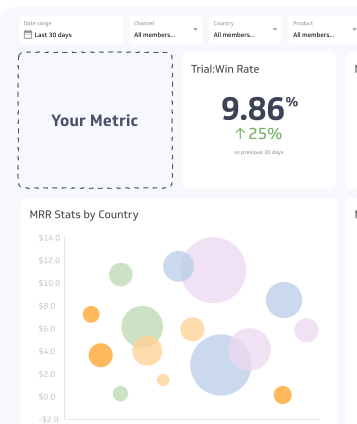
Your aim with visualizing Ad Impressions should be to quickly identify ad variations with the highest impressions, as well as tracking the overall number of impressions. The best data visualizations for Ad impressions are bar charts to segment your data by ad variation or campaign, and summary charts to measure the current value versus previous time periods.
Ad impressions measure how often an ad appears on a user's screen. Each time an ad loads, whether or not the user interacts with it, counts as one impression. Impressions apply across ad formats: search ads, display ads, video ads, social ads, and most other digital placements. You can also measure Ad Set Impressions, which tracks impressions for a group of ads under the same theme. This metric is a leading indicator of reach. It tells you how much exposure your ad is getting before you evaluate clicks, conversions, or return on spend.
How ad impressions are counted
Impressions count every ad load, not every unique viewer. If one person sees your ad four times, that registers as four impressions. If four different people each see it once, that also registers as four impressions. The number of impressions you receive depends on several factors:
-
Audience size: A broader target audience creates more potential ad loads
-
Budget: Higher spend generally increases delivery volume
-
Ad relevance: Platforms reward ads that match audience intent with more distribution
-
Quality score: Platforms like Google use quality scores to determine how often and where your ad appears
-
Bid strategy: Competitive bids in high-demand placements drive higher impression volume
How to use ad impressions in practice
Impressions serve different purposes depending on your campaign goal and stage. Brand awareness campaigns treat impressions as a primary success metric. The goal is reach, so a high impression count signals that your message is getting in front of your audience. Frequency caps help prevent overexposure to the same users. Performance campaigns use impressions as a diagnostic metric rather than a goal. Low impressions on a performance campaign may indicate a delivery problem, a budget constraint, or a targeting issue, not a creative problem. A/B testing relies on impressions to ensure each ad variation gets enough exposure to produce statistically meaningful results. An ad with 435 impressions is not comparable to one with 16,000.
Impressions vs. reach
Impressions and reach are related but distinct.
Metric | What it measures |
|---|
Impressions | Total ad loads, including repeat views by the same user |
Reach | Number of unique users who saw the ad at least once |
A high impression count with low reach means a small audience is seeing your ad repeatedly. This can build familiarity but may also cause ad fatigue. Monitoring both metrics together gives you a clearer picture of exposure efficiency. For a deeper look at how these two metrics compare, see Ad Reach vs Ad Impressions.
Impression share and advanced applications
More advanced advertisers use impressions beyond raw counts. Impression share is the percentage of total available impressions your ad received compared to the total it was eligible for. A low impression share signals that budget, bid, or quality constraints are limiting your reach. Frequency analysis uses impressions relative to reach to calculate average views per user. High frequency can indicate audience saturation, which often leads to declining click-through rates over time. Bid strategy adjustments on platforms like Google Ads can be tied directly to impression share targets, allowing automated bidding to pursue a defined share of available inventory.
Common challenges
Impressions do not equal attention. An ad loading on a page does not confirm a user saw it. Viewability metrics, which measure whether an ad was actually in the visible portion of the screen, provide a more reliable signal of genuine exposure. Inflated counts from bots and invalid traffic. Ad fraud can artificially inflate impression numbers. Most major platforms filter invalid traffic, but monitoring for unusual spikes in impressions without corresponding engagement is a sound practice. Comparing impressions across platforms. Each platform counts impressions differently. Google Ads, Meta, and LinkedIn each have their own definitions of when an impression is recorded. Cross-platform comparisons require careful interpretation.