What is Ad Spend?
Ad Spend is the total money spent on advertising over a set period, which you can break down by campaign, ad set, or individual ad. It shows where your budget went, not whether the spending worked. Marketers use it to control budgets, report accurately, and judge performance alongside results such as conversions and revenue. Tracking it clearly helps you decide where to move budget and when to pause or scale a campaign.
Ad Spend Formula
How to calculate Ad Spend
Say an ad set has a daily budget of $200 and contains five ads. Ad networks rarely split spend evenly. Unless you set rules otherwise, they send more budget to the ads they predict will perform best.
| Ad | Spend |
|---|---|
| Ad 1 | $100 |
| Ad 2 | $50 |
| Ad 3 | $25 |
| Ad 4 | $20 |
| Ad 5 | $5 |
| Ad set total | $200 |
Formula: Ad Spend = Sum of the cost charged for each ad in the period.
Ad Spend for the ad set is $100 + $50 + $25 + $20 + $5 = $200. Ad 1 took half of it. That tells you the network favoured Ad 1. It does not tell you whether Ad 1 earned its share, so check conversions or revenue for each ad before moving budget.
Explore Ad Spend sample data
This visualization is a live embed from Klipfolio PowerMetrics.
Start tracking your Ad Spend data
Use PowerMetrics, modern analytics platform, to monitor your data. Choose a service below to start tracking your Ad Spend instantly.




How to visualize Ad Spend?
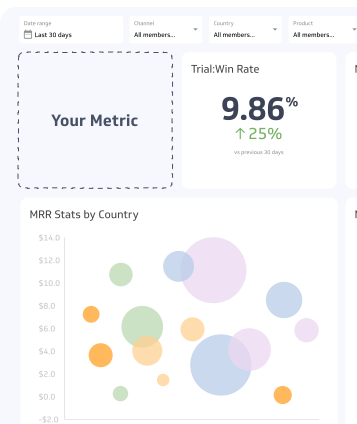
Use a summary chart to visualize your Ad Spend. This displays the current value which you can then compare to a previous period, allowing you to monitor spend.
Ad Spend visualization example

Summary Chart
Here's an example of how to visualize your current Ad Spend data in comparison to a previous time period or date range.
More about Ad Spend
How to interpret Ad Spend
Ad Spend is an input, so read it next to an outcome. A high number is neither good nor bad on its own. A $50,000 month that returns $200,000 in revenue is a different story from a $5,000 month that returns nothing.
Use it to answer three questions:
- Is spending on plan? Compare actual Ad Spend to the budget for the same period.
- Where is the money going? Compare spend by channel, campaign, and ad to find concentration.
- Is the spend earning a return? Pair it with results, such as conversions or revenue.
What drives Ad Spend up or down
Several factors change how much you spend, even when your budget stays the same.
- Budget and bid settings. Daily or lifetime budgets, bid caps, and target costs set the ceiling and the pace.
- Audience size and competition. Crowded audiences and busy seasons raise auction prices, so each click or impression costs more.
- Ad relevance and quality. Networks tend to give more delivery to ads they expect to perform, which concentrates spend.
- Schedule and flight dates. Pausing, extending, or launching campaigns changes the total for the period.
- Platform pacing rules. Some platforms can spend above the daily budget on a single day and balance it out over the week or month. Check each platform's current rules before comparing daily figures to budget.
Common variations in how Ad Spend is defined
Teams do not always count the same costs. Agree on one definition before comparing periods or channels.
| Version | What it includes | When it fits |
|---|---|---|
| Media spend | Only what the ad platforms charge | Channel and campaign reporting |
| Media spend plus taxes | Platform charges plus sales taxes or fees billed to you | Reconciling to invoices and finance records |
| Fully loaded ad cost | Media spend plus agency fees, creative production, and ad tools | Calculating total marketing cost or profitability |
Most platform dashboards show media spend. Finance teams often work from invoices, so the two totals may not match. Currency conversion and billing timing can add small differences.
Best practices for tracking Ad Spend
- Track at the ad level and roll up. Ad-level data lets you see concentration and still report totals for campaigns.
- Use consistent time periods. Compare the same date ranges, and note the time zone of each ad account.
- Use consistent naming. Campaign and ad names that follow one pattern make it simple to group spend by product, audience, or goal.
- Reconcile monthly. Compare platform totals to invoices or card statements to catch missing charges or timing gaps.
- Set alerts or checkpoints. Review spend against budget weekly so overspending does not go unnoticed until month end.
- Pair spend with outcomes. Review it next to results every time it appears in a report.
Common challenges and misreadings
Treating spend as performance. More spend does not mean more success. An ad with the most spend may simply be the one the platform chose to favour early.
Judging ads before they have enough data. An ad with $5 of spend has too little data to compare against one with $100. Wait for enough volume before cutting or scaling.
Mixing definitions. Comparing media spend in one report to fully loaded cost in another produces misleading gaps.
Counting duplicates. If you combine data from several platforms or exports, make sure the same spend is not added twice.
Ignoring attribution. Spend is recorded on the platform that charged for it, but the sale may be credited elsewhere. Look at Ad Spend by channel with that in mind.
Related metrics
Ad Spend becomes useful when paired with metrics that show what it bought.
- Cost per Click (CPC): Ad Spend / Clicks. Shows what each visit cost.
- Cost per Acquisition (CPA): Ad Spend / Conversions. Shows what each conversion cost.
- Return on Ad Spend (ROAS): Revenue from ads / Ad Spend. Shows revenue earned per dollar spent.
- Customer Acquisition Cost (CAC): Total sales and marketing cost / New customers. A broader measure that includes more than ad costs.
Ad Spend Frequently Asked Questions
What is Ad Spend?
Ad Spend is the total money spent on advertising over a set period. You can break it down by campaign, ad set, or individual ad.
Does high Ad Spend mean an ad is performing well?
No. Ad Spend shows where the budget went, often because the platform favoured an ad. Check conversions or revenue to judge performance.
Why might Ad Spend differ from my invoices?
Platform dashboards usually show media spend only. Invoices can include taxes and fees, and currency conversion or billing timing can add small differences.
Can a platform spend more than my daily budget?
Some platforms can spend above the daily budget on a single day and balance it out over the week or month. Check each platform's current rules.