What is Ad Reach?
Ad Reach is the number of unique people who saw your ad at least once during a set period. It shows how many individuals your message got in front of, not how many times it was shown. Ad Reach helps you judge the size of your exposure and estimate the brand awareness a campaign may build. It informs decisions about budget, audience size, and how widely to spread a message. Platforms define a person differently, so check each definition before comparing numbers.
Ad Reach Formula
How to calculate Ad Reach
Say you advertise to an audience of 100,000 people. Your campaign delivers 90,000 Impressions, and the platform reports an Ad Reach of 45,000.
- Reach rate: 45,000 / 100,000 × 100 = 45%
- Frequency: 90,000 / 45,000 = 2
Your ad reached 45% of the audience, and the average person who saw it saw it twice. The other 55,000 people haven't seen it yet.
Start tracking your Ad Reach data
Use PowerMetrics, modern analytics platform, to monitor your data. Choose a service below to start tracking your Ad Reach instantly.

How to visualize Ad Reach?
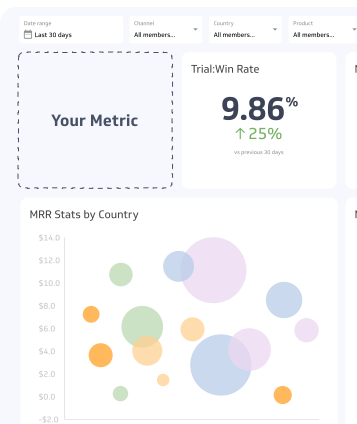
Use a summary chart to best visualize your Ad Reach data. This type of chart compares the current value to a previous time period.
Ad Reach visualization example

Summary Chart
Here's an example of how to visualize your current Ad Reach data in comparison to a previous time period or date range.
More about Ad Reach
How to interpret Ad Reach
A higher Ad Reach means more people have been exposed to your message. On its own, though, the number says little. Read it against the size of the audience you're targeting.
- Narrow audience: Ad Reach can't exceed the audience. If you target 10,000 people, a reach of 9,000 is near saturation, and extra budget will mostly raise Frequency.
- Broad audience: Reach rate shows how much of the market you've covered. Budget and ad relevance usually set how far you get.
Ad Reach also feeds awareness estimates. Reach alone doesn't confirm that people noticed, remembered, or acted on the ad.
Ad Reach vs Impressions and Frequency
Impressions count every time an ad is displayed. Ad Reach counts each person once. Frequency links the two.
| Metric | What it counts | Question it answers |
|---|---|---|
| Ad Reach | Unique people who saw the ad | How many people did we get to? |
| Impressions | Total ad displays | How often was the ad shown? |
| Frequency | Impressions per person reached | How often did each person see it? |
Impressions almost always exceed Ad Reach, because the same person usually sees an ad more than once. A single exposure rarely changes behaviour, so you want enough repeat views for the message to register. Too many repeats can lead to ad fatigue.
What drives Ad Reach up or down
- Budget. More spend buys more delivery, which usually widens reach until the audience is saturated.
- Audience size. A larger targeted audience raises the ceiling on reach.
- Targeting and relevance. Relevant ads often win more auctions and reach more people for the same spend.
- Bidding and optimization goal. Reach-focused campaigns spread impressions across new people. Click or conversion goals often concentrate on likely responders, which can lower reach.
- Frequency caps. Limiting how often one person sees the ad pushes delivery to new people.
- Placements and channels. Adding placements or channels brings in people the first one missed.
- Campaign length. Reach grows over time, but gains slow as the pool of new people shrinks.
Using Ad Reach in practice
Awareness campaigns
Reach is a primary measure here. Set a target reach rate, then watch Frequency so you don't overspend on people who have already seen the ad. Compare cost per 1,000 people reached across channels.
Conversion campaigns
Treat Ad Reach as a supporting metric. If reach has flattened while Frequency climbs, new creative or a new audience will usually help more than extra budget.
Comparing channels
Platforms define and deduplicate reach differently, so don't add reach numbers across channels. Compare each channel's trend against itself, and use a cross-channel measurement tool if you need an unduplicated total.
Common challenges with Ad Reach
- Counting overlap. Summing reach across campaigns or platforms double counts people.
- Treating reach as attention. A counted person may have scrolled past the ad. Pair reach with engagement or brand lift measures.
- Ignoring audience size. A reach of 45,000 is strong against a 60,000 audience and weak against 5 million.
- Estimated figures. Some platforms report modelled reach, so expect small differences from your own analytics.
- Changing the reporting window. A weekly and a monthly reach figure aren't comparable, because unique people accumulate over time.
Best practices for tracking Ad Reach
- Define the reporting period and keep it the same across comparisons.
- Report reach rate alongside the raw count.
- Track Frequency with Ad Reach to see whether growth comes from new people or repeat views.
- Note how each platform defines a person.
- Review reach by segment, such as region or age group, to find where coverage is thin.
Ad Reach Frequently Asked Questions
What is the difference between Ad Reach and Impressions?
Ad Reach counts each unique person who saw your ad once. Impressions count every time the ad was displayed, including repeat views by the same person. Impressions are usually higher.
How do you calculate reach rate?
Divide Ad Reach by the size of your target audience and multiply by 100. For example, 45,000 people reached out of an audience of 100,000 is a 45% reach rate.
Can Ad Reach be higher than my audience size?
It shouldn't be if the audience is fixed, but it can appear to when a platform estimates audience size, or when reach includes people outside your targeting. Treat large gaps as a sign to check the platform's definitions.