Ad Unique Clicks is a count of the distinct people who clicked your digital ad at least once. Unlike Total Ad Clicks, which counts every click, Ad Unique Clicks counts each person once regardless of how many times they clicked.
Your campaign has been running for two weeks. Here's what the data shows:
Ad 1 — Total Clicks: 14,000
Ad 1 — Unique Clicks: 10,000
This means 10,000 individual people clicked the ad. The remaining 4,000 clicks came from people who clicked more than once. The gap between Total Clicks and Unique Clicks shows how much repeat engagement your ad is generating.
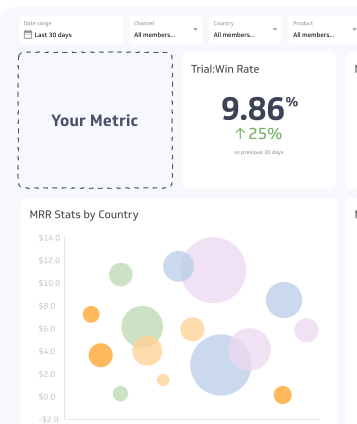
You can use a summary chart to compare the current count of Ad Unique Clicks to a previous time period. Take a look at the example:
How to use Ad Unique Clicks
Measure true audience reach
Total Clicks can inflate the apparent size of your audience. Ad Unique Clicks gives you a cleaner picture of how many distinct people your ad actually reached and engaged. Use this metric when you want to understand reach, not just volume.
Identify repeat engagement patterns
Comparing Total Clicks to Unique Clicks reveals your repeat-click rate. High repeat engagement can indicate strong creative or audience interest. It can also point to accidental clicks or ad placement issues, particularly on mobile where mis-taps are common.
Spot potential ad fraud
A suspicious gap between Total Clicks and Unique Clicks, especially on smaller or less-established ad networks, can be a signal of click fraud or inflated reporting. If you see thousands of total clicks but very few unique clickers, investigate the traffic source before increasing spend.
Compare creative performance
When running A/B tests across ad variations, Unique Clicks helps you evaluate which creative is reaching more distinct people. An ad with higher Unique Clicks but lower Total Clicks may be attracting a broader audience, even if individual engagement depth is lower.
Limitations to keep in mind
Cookie-based tracking has real constraints. A single person can be counted as multiple unique clickers if they:
- Click the ad on their phone and again on their laptop
- Clear their browser cookies between sessions
- Use a private or incognito browsing window
These gaps mean Unique Clicks can undercount or overcount depending on user behaviour. Cross-device tracking has improved on major platforms, but no method is perfectly accurate.
Treat Ad Unique Clicks as a directional signal rather than an exact count. It is most reliable when used consistently over time and compared against other engagement metrics like Click-Through Rate and Ad Impressions.