Cost Per Thousand (CPM) is the price an advertiser pays for 1,000 ad impressions on a webpage or digital platform. Also called Cost Per Mille, CPM is one of the most widely used pricing models in digital advertising. It measures how much an advertiser spends to reach 1,000 people, making it a standard benchmark for comparing the cost-efficiency of campaigns across channels and audiences.
A retailer spends $750 to generate 300,000 impressions on a news site.
CPM = ($750 / 300,000) × 1,000 = $2.50
That means the advertiser paid $2.50 for every 1,000 times the ad appeared.
Reverse calculation: if the site charges a flat $3.00 CPM and the advertiser has a $900 monthly budget, they can expect ($900 / $3.00) × 1,000 = 300,000 impressions per month.
CPM benchmarks vary by channel and industry. General ranges for digital advertising:
| Channel | Typical CPM range |
|---|
| Display advertising | $1–$10 |
| Social media (Facebook, Instagram) | $5–$15 |
| LinkedIn | $25–$50+ |
| Connected TV (CTV) | $15–$40 |
| Programmatic video | $10–$30 |
These are directional ranges. Benchmark against your own historical data and industry-specific sources.
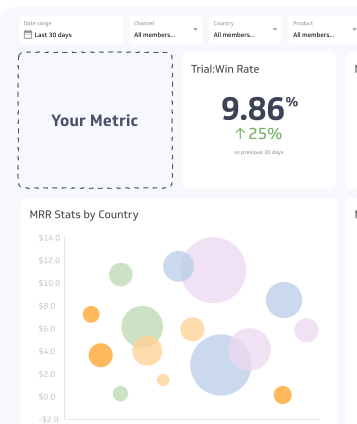
You can use a simple summary chart to effectively visualize your overall Cost Per Thousand data. Additionally, you can segment this data by campaign using a bar chart to study your performance in more detail.
CPM suits campaigns where the primary goal is reach and visibility rather than direct response. It answers the question: how efficiently are we getting the brand in front of people?
Common use cases include:
- Brand awareness campaigns — reaching a broad audience with a new product, rebrand, or seasonal message
- Audience building — growing familiarity before a conversion-focused campaign
- Display and video advertising — channels where impressions are the natural unit of delivery
CPM is less informative when the goal is clicks, leads, or purchases. In those cases, Cost Per Click (CPC) or Cost Per Acquisition (CPA) are better measures of campaign efficiency.
What affects CPM rates
CPM is not fixed. Rates vary widely based on several factors.
| Factor | Effect on CPM |
|---|
| Platform | Premium platforms (LinkedIn, connected TV) command higher CPMs than open web display |
| Audience targeting | Narrower, higher-value audiences cost more to reach |
| Ad format | Video and rich media typically carry higher CPMs than static display |
| Seasonality | Q4 and major shopping periods drive up demand and rates |
| Ad placement | Above-the-fold or homepage placements cost more than lower-visibility spots |
| Industry | Finance, insurance, and B2B verticals tend to have higher CPMs |
Understanding these variables helps advertisers interpret CPM benchmarks in context rather than applying a single standard across all campaigns.
CPM vs. other ad pricing models
CPM is one of three common digital ad pricing structures. Each suits different campaign objectives.
| Model | What you pay for | Best for |
|---|
| CPM | 1,000 impressions | Brand awareness, reach |
| CPC (Cost Per Click) | Each click | Traffic, consideration |
| CPA (Cost Per Acquisition) | Each conversion | Lead gen, direct response |
Many campaigns use a mix. A brand might use CPM for top-of-funnel awareness, then shift to CPC retargeting to drive traffic, and CPA tracking to measure conversions.
Common challenges with CPM
Impressions don't equal attention. An ad can be counted as an impression even if a user scrolls past it in under a second. Viewability rate — the percentage of impressions where the ad was actually on screen long enough to be seen — is a more meaningful complement to CPM.
Invalid traffic inflates impression counts. Bot traffic and ad fraud can make CPM look artificially efficient. Use platforms and measurement tools that filter for invalid traffic.
CPM alone doesn't measure impact. A low CPM is only valuable if the impressions reach the right audience. Pair CPM with reach, frequency, brand lift, or downstream conversion data to get a complete picture of campaign performance.
Frequency management matters. High impression volume can mean the same users see an ad many times. Monitor frequency caps to avoid audience fatigue, which reduces engagement and wastes spend.