What is Emails Delivered?
Emails Delivered is the total number of emails successfully delivered to recipients' inboxes, excluding bounces and unsubscribed contacts. It is the starting point for calculating delivery rate and evaluating list health.
Emails Delivered Formula
Start tracking your Emails Delivered data
Use PowerMetrics, modern analytics platform, to monitor your data. Choose a service below to start tracking your Emails Delivered instantly.


How to visualize Emails Delivered?
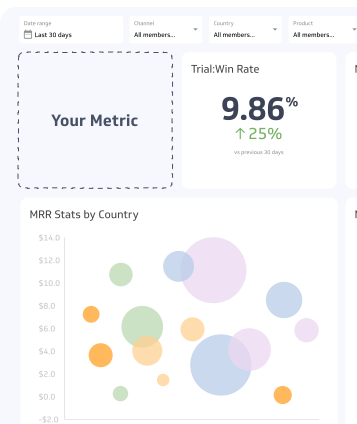
Measure your email deliveries in a summary chart, sometimes known as a metric chart. This type of data visualization will let you compare your email deliveries in the current period with a previous time period, indicating if your email campaign is effective at getting your message into inboxes.
Emails Delivered visualization example

Summary Chart
Here's an example of how to visualize your current Emails Delivered data in comparison to a previous time period or date range.
More about Emails Delivered
Email deliverability sits at the foundation of every email marketing program. If your messages don't reach inboxes, every downstream metric — opens, forwards, click-throughs — becomes meaningless. Tracking Emails Delivered tells you how many contacts your campaign actually reached, and it serves as the starting point for calculating delivery rate and diagnosing list health.
How Emails Delivered is calculated
The formula is straightforward:
Emails Delivered = Emails Sent ? Bounces
Unsubscribed contacts are excluded from sends before delivery is attempted, so they don't factor into the bounce calculation. The result is a count of messages that reached a recipient's mail server without being rejected.
Why Emails Delivered matters
A high send volume means little if a significant portion never arrives. Monitoring Emails Delivered helps you:
- Identify list decay — a rising bounce rate signals outdated or invalid addresses
- Protect sender reputation — inbox providers track bounce rates and flag senders who consistently hit invalid addresses
- Benchmark campaign reach — comparing Emails Delivered across campaigns reveals whether your audience is growing, shrinking, or staying stable
- Interpret engagement metrics accurately — open rates, click rates, and conversion rates are all calculated against delivered volume, so inflated or deflated delivery counts distort every ratio downstream
Improving email deliverability
Regulations, inbox filtering technologies, and recipient behaviour all make deliverability harder to maintain over time. The following practices give your emails the best chance of reaching the inbox.
Authenticate your sending domain. Set up SPF, DKIM, and DMARC records so inbox providers can verify you're a legitimate sender. Authentication is the single highest-leverage step for improving deliverability.
Use confirmed opt-in (double opt-in). Asking recipients to confirm their subscription reduces invalid addresses, improves engagement rates, and signals to inbox providers that your list is high quality.
Send from a custom domain. Avoid sending from free email domains such as Gmail, Yahoo, or Hotmail. Inbox providers treat messages from free domains with greater suspicion, especially at volume.
Prioritize content quality. Avoid clickbait subject lines, excessive images, and overuse of buttons. Messages that look like spam get treated like spam — by filters and by recipients.
Keep links transparent. Include full, readable URLs in your emails. URL shorteners obscure destinations and can trigger spam filters.
Make it easy to unsubscribe. Clear, accessible unsubscribe options are required by law in most jurisdictions, including Canada's CASL and the U.S. CAN-SPAM Act. Easy unsubscribes keep your list clean, reduce spam complaints, and improve your sender reputation over time.
Emails Delivered and list hygiene
Deliverability degrades when lists aren't actively maintained. Contacts change email addresses, abandon inboxes, or mark messages as spam. Routine list hygiene practices — removing hard bounces immediately, suppressing chronic non-openers, and validating new addresses at the point of capture — protect your Emails Delivered count and your sender reputation simultaneously.
Monitoring Emails Delivered alongside your email unsubscribe rate gives you a complete picture of list health: deliverability tells you who can be reached; unsubscribes tell you who no longer wants to be.
Emails Delivered Frequently Asked Questions
What is a good email delivery rate?
Aim to get as close to 100% email delivery rate as you can. In general, a good email delivery rate is about 95%.
What's the difference between email delivery and deliverability?
Email delivery is the rate of emails that are successfully delivered to your email list, while email deliverability refers to where the email lands upon delivery (primary inbox, promotions, spam).