Website Visits, also referred to as sessions, track the number of times users interact with your website during distinct periods of engagement. Each visit, or session, represents a continuous interaction that begins when a user arrives and ends after 30 minutes of inactivity or when they leave the site.
Let's say you're running a campaign for a new product launch:
Day 1: 1,000 users visit your site, generating 1,200 visits/sessions (some users returned within the day after timeout periods)
Day 2: 800 users visit, generating 950 visits/sessions
Day 3: 1,200 users visit, generating 1,400 visits/sessions
Your total visits for the three-day period would be 3,550, even though your unique users/visitors might only total 2,500 (accounting for overlap between days). This difference shows you the level of repeat engagement your campaign is driving—the same people are coming back multiple times.
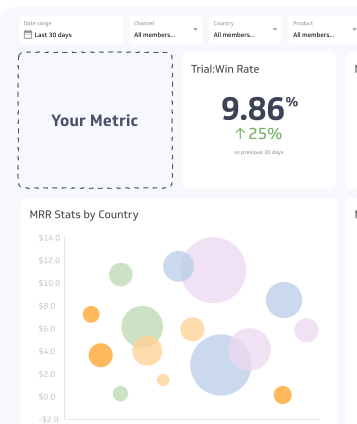
Use a summary chart to visualize your Website Visits data and compare it to a previous time period.
It's important to understand the terminology nuances in web analytics. Website Visits and Sessions are the same metric—they both measure individual periods of user engagement with your site. Similarly, Website Visitors and Users are the same metric—they both count unique individuals who visit your site. This distinction is crucial: one visitor (user) can generate multiple visits (sessions) over time. For example, if Sarah visits your site on Monday morning, then returns Tuesday afternoon, that's 1 visitor generating 2 visits/sessions.
Understanding website visits (sessions) is crucial for measuring your marketing effectiveness because each visit represents a distinct engagement opportunity with your content and brand. Unlike page views, which can be inflated by users clicking through multiple pages within the same visit, website visits give you a clearer picture of actual engagement instances. Each visit represents a potential conversion event, whether that's a purchase, lead generation, or brand awareness interaction created by your marketing efforts.
Website visits (sessions) are automatically tracked by analytics platforms, but understanding the calculation helps you interpret the data correctly. A visit begins when a user arrives on your website and ends after 30 minutes of inactivity (by default in Google Analytics 4) or when the user leaves your site. If the same user returns after the timeout period or on a different day, it counts as a new visit/session.
Strategic Context for Marketing Decision-Making
Website visits serve as a fundamental metric for evaluating marketing performance and understanding user engagement patterns. When mapping visits to your marketing funnel, they represent discrete engagement opportunities where users interact with your brand. A spike in visits following a campaign launch indicates successful reach, but analyzing visit quality through related metrics like session duration and pages per session provides deeper insights into campaign effectiveness.
For campaign optimization, track visits alongside their sources (organic search, paid ads, social media, email) to identify which channels drive the most engaged traffic. This data informs budget allocation decisions and helps you double down on high-performing channels while optimizing or eliminating underperforming ones. Understanding the relationship between visitors and visits also reveals user behaviour patterns—high visits-to-visitors ratios indicate strong brand loyalty and content engagement.
Website visits provide crucial context for understanding customer journey complexity. In B2B marketing, for example, decision-makers often require multiple visits before converting. Tracking visit patterns helps you set realistic attribution windows and avoid prematurely cutting campaigns that drive valuable research and consideration-stage interactions.