A clothing retailer publishes styling tips on their blog. Last month, the blog recorded 50,000 total sessions. Of those, 20,000 came from first-time visitors. Percent New Sessions = 20,000 / 50,000 = 40%. That result means 40% of sessions were from new visitors and 60% from returning users. For a content-driven site, this balance suggests a loyal returning audience alongside a steady flow of new traffic.
Percent New Sessions
Last updated: Aug 27, 2026
What is Percent New Sessions?
Percent New Sessions is the share of total website sessions started by first-time visitors. It measures both audience growth and how well a site retains existing users, helping teams balance acquisition and retention goals.
Percent New Sessions Formula
ƒ Count(New Sessions) / Count(Total Sessions)
How to calculate Percent New Sessions
Start tracking your Percent New Sessions data
Build and track this metric in PowerMetrics, a modern analytics platform that lets you define metrics and connect your own data.
Get PowerMetrics Free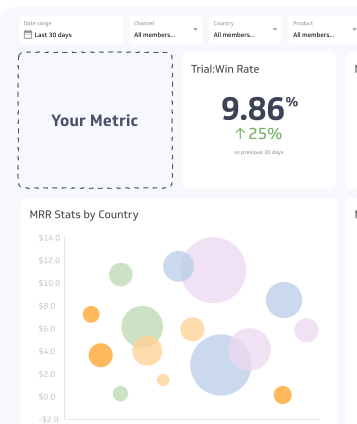
How to visualize Percent New Sessions?
Use a line chart to visualize changes in your Percent New Sessions data over time.
Percent New Sessions visualization example
Percent New Sessions

Line Chart
Here's an example of how to visualize your Percent New Sessions data in a line chart over time.

Percent New Sessions
Chart
Measuring Percent New SessionsMore about Percent New Sessions
How to interpret and apply Percent New Sessions
What the number tells you
A high Percent New Sessions (above 60 to 70%) signals strong reach or a successful acquisition campaign, but it can also indicate weak retention. A low percentage (below 30%) suggests a loyal core audience but limited growth in new visitors. Neither extreme is inherently good or bad; the right balance depends on your goals.
For a brand-awareness campaign, you want this number rising. For a subscription product or community site, a lower percentage often reflects healthy retention.
How business stage shapes the target
Early-stage sites typically need a high Percent New Sessions. Growth depends on attracting new visitors, and a figure above 60% is common and desirable.
Mature sites with established audiences often see this metric settle between 30% and 50%. At that stage, a stable or slightly declining percentage may reflect strong user loyalty rather than a problem.
Seasonal or campaign-driven sites will see spikes during promotions. Tracking the metric before, during, and after a campaign reveals whether new visitors convert to returning ones.
What drives it up or down
Several factors shift Percent New Sessions in either direction:
Paid acquisition and SEO: A surge in search rankings or a paid campaign brings new visitors quickly, pushing the metric up.
Referral and social traffic: Viral content or press coverage introduces new audiences, often producing a short-term spike.
Email and push notifications: Channels that primarily re-engage existing users pull the percentage down by increasing returning sessions.
Content strategy: Evergreen content attracts new visitors over time; community features and personalization encourage returns.
Common pitfalls
Treating the metric in isolation is the most common mistake. Percent New Sessions says nothing about what new visitors do once they arrive. Pair it with sessions, bounce rate, and conversion rate to understand whether new traffic is valuable.
Cookie and tracking limitations distort the number. A returning visitor who clears cookies, switches browsers, or uses a private window appears as a new session. As third-party cookie deprecation continues, this inflation effect is growing. Treat the metric as directional rather than precise.
Averaging across the whole site can hide meaningful differences. A blog may attract 70% new sessions while a logged-in product area sits at 10%. Segment by page type, traffic source, or user cohort before drawing conclusions.
Adjacent metrics to track alongside it
| Metric | Why it pairs well |
|---|---|
| Sessions | Provides the total volume context for the percentage |
| Bounce rate | Reveals whether new visitors engage or leave immediately |
| Conversion rate | Shows whether new traffic translates to outcomes |
| Return visitor rate | The direct complement; the two always sum to 100% |
Tracking Percent New Sessions alongside these metrics gives a fuller picture of both acquisition efficiency and retention health.
Recommended resources related to Percent New Sessions
Google Analytics definition of Percent New SessionsContributor