Call-in Rate is the average number of inbound calls received per paid user of a product or service. It monitors changes in call volume, which can be an early warning sign of product or service issues and potential churn.
A business with 1,000 subscribers received 3,000 inbound calls last week.
CIR = 3,000 / 1,000 = 3
A CIR of 3 means each subscriber called in an average of three times that week. Whether that number is acceptable depends on the business model and trend direction, but a sustained rate above 4 in telecom typically signals a support or product problem worth investigating.
In telecom, a CIR of 3 to 4 on a weekly basis is a commonly cited reference point for a healthy support operation. That range reflects an industry with complex billing, hardware dependencies, and a broad customer base that includes less technically confident users. For SaaS businesses with strong self-service infrastructure, a lower CIR is achievable and expected. The most useful benchmark is your own historical trend: set a baseline, then measure whether product changes, support investments, or channel shifts move the number in the intended direction.
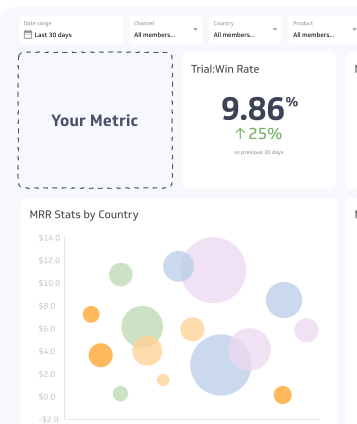
A line chart can help you optimally visualize your Call-in Rate data by letting you see how this metric trends over time. You can then adjust your strategy to meet your goals.
Why Call-in Rate matters
Every inbound call carries a cost on both sides. For customers, placing a call interrupts their work and creates friction. For companies, staffing a support line with trained agents is expensive, and that cost scales directly with call volume.
Tracking CIR over time gives support and product teams an early signal before problems compound. A sudden spike often points to a bug in a recent software release, a billing system error, or a service outage. A gradual climb can indicate that a product feature is confusing users or that self-service channels are failing.
The direction of CIR matters as much as the absolute number. As a company grows, CIR should stay flat or decrease. If subscriber counts double but call volume triples, the support operation is not scaling efficiently.
What drives CIR up or down
Several factors push CIR higher or lower:
Product quality: Bugs, confusing UX, or a poorly communicated feature release tend to spike inbound call volume quickly.
Self-service effectiveness: When a knowledge base, chatbot, or customer portal resolves common questions, fewer customers reach for the phone.
Billing complexity: Unclear invoices or unexpected charges are a reliable driver of inbound calls. Simplifying billing communications can reduce CIR without any product change.
Customer mix: New customers call more often than tenured ones. A period of rapid acquisition can temporarily lift CIR even when nothing else changes.
Channel preferences: Research consistently shows that customers increasingly prefer self-service, digital community, and chat options over phone calls. Businesses that invest in those channels see sustained CIR reduction.
Interpreting a drop in CIR
A falling CIR is not automatically good news. Two very different situations produce the same downward trend:
- Self-service is working. Customers are resolving issues through a portal, app, or knowledge base. This is the outcome most businesses are aiming for.
- Customers are disengaging. Frustrated users stop calling not because their problems are solved, but because they no longer expect a useful response. This pattern often precedes churn.
To distinguish between the two, track CIR alongside customer satisfaction scores and churn rate. If CIR falls while satisfaction holds steady or improves, self-service is doing its job. If CIR falls while satisfaction drops or churn rises, disengagement is the more likely explanation.
Related metrics
First Call Resolution (FCR): Measures whether a customer's issue is resolved on the first call. High FCR reduces repeat calls and keeps CIR lower.
Customer Satisfaction Score (CSAT): Tracks how customers feel after a support interaction. Pairing CSAT with CIR helps distinguish healthy disengagement from frustrated silence.
Churn Rate: CIR spikes that are not addressed often precede increased churn. Monitoring both together gives a more complete picture of customer health.