Website Bounces is the count of sessions in which a visitor lands on a page and leaves without triggering any further interaction. Website Bounces are most often expressed as Bounce Rate: the number of single-page sessions divided by total sessions for that page, multiplied by 100.
A product landing page receives 4,000 sessions in a month. Of those, 1,800 visitors leave without clicking anything else.
Bounce Rate = 1,800 / 4,000 × 100 = 45%
That means 45% of visitors saw one page and left. Whether that signals a problem depends on the page's purpose and what visitors were expected to do next.
Bounce rates typically range from 35% to 80%, varying by page type and traffic source. Blog and content pages often see 65%–90%; e-commerce product pages 45%–65%; landing pages 60%–90%; and service or contact pages 35%–55%. Segment by page type and traffic source before drawing conclusions, as aggregate site-wide bounce rate is rarely actionable. (General industry ranges; see Google Analytics benchmarks and HubSpot research, 2023–2024.)
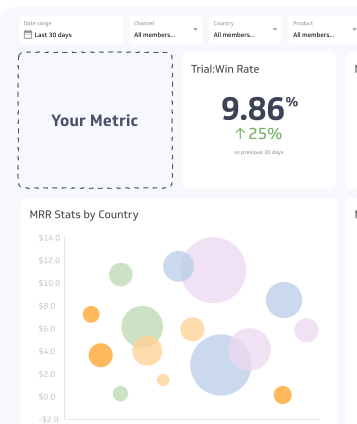
Use a summary chart to visualize your Website Bounces data and compare it to a previous time period.
Bounce Rate is a measure of content-audience fit. When the right visitors land on the right content, they stay and explore. When they don't, they leave.
A high bounce rate can signal several different things:
The page content doesn't match visitor expectations based on the link or ad that brought them there
The page loads too slowly, and visitors abandon before it finishes
The page answers the visitor's question completely, so there's nothing left to do
The audience being attracted isn't the right one for the content
Bounce Rate doesn't distinguish between a disappointed visitor and a satisfied one. A visitor who reads a blog post in full and leaves having found exactly what they needed is counted the same as someone who bounced in two seconds.
Single-page sites and landing pages
If your site is a single-page experience, or if a landing page is designed to drive one action (filling out a form, calling a phone number, clicking an outbound link), almost every visit will register as a bounce — even successful ones.
In these cases, Bounce Rate is a poor standalone metric. Look at it alongside:
Average Session Duration — Are visitors spending time on the page, or leaving immediately?
Conversion Rate — Are visitors completing the intended action?
Scroll depth — Are visitors engaging with the content before leaving?
These metrics together give a more complete picture of page performance than Bounce Rate alone.
Common mistakes when interpreting bounces
Treating all bounces as failures. A bounce on a contact page where the visitor found your phone number is a success. Context determines whether a bounce is a problem.
Ignoring session duration. A 10-second bounce and a 4-minute bounce look identical in raw bounce count. Use time-on-page alongside bounce rate to separate disengaged visitors from satisfied ones.
Comparing across page types. A blog post and a checkout page serve different purposes and will naturally have very different bounce rates. Compare like with like.
Not checking for tracking errors. Duplicate analytics tags, misconfigured events, or missing tags can artificially inflate or deflate bounce rate. Verify your setup before acting on the numbers.
How to reduce bounce rate
When bounce rate is genuinely high and indicates a problem, focus on these areas:
Improve page load speed. Pages that take more than 3 seconds to load see significantly higher abandonment. Compress images, minimize scripts, and use a content delivery network.
Align content with intent. If visitors arrive from a specific search query or ad, the page should directly address what that query or ad promised.
Strengthen internal linking. Give visitors a clear next step. Related content, contextual links, and calls to action reduce exits.
Improve mobile experience. A page that works well on desktop but poorly on mobile will drive higher bounce rates from mobile visitors.
Review audience targeting. If paid campaigns are driving high-bounce traffic, the audience targeting or ad creative may be misaligned with the landing page.