Media Reach is the total number of unique people exposed to your content or campaign during a specific time period. It differs from impressions, which count total exposures including repeats. Marketers use reach to measure audience size, evaluate campaign spread, and inform budget and channel decisions.
A regional food brand runs a paid social campaign across two platforms over two weeks. Platform A reaches 42,000 unique users; Platform B reaches 31,000 unique users. Research shows 8,000 users saw the ad on both platforms.
Media Reach = 42,000 + 31,000 ? 8,000 = 65,000
The campaign reached 65,000 unique people. Without deduplicating the overlap, the brand would have overstated reach by more than 12%.
Reach benchmarks vary by channel, industry, and budget. Organic Facebook reach typically falls between 1%–6% of page followers; Instagram organic reach ranges from 3%–15% of followers (Hootsuite Digital Trends Report, 2024). Email open rates — a common proxy for reach — average 20%–40% across industries (Mailchimp Email Benchmarks, 2024). Paid social reach is determined by targeting parameters and spend, with no universal benchmark.
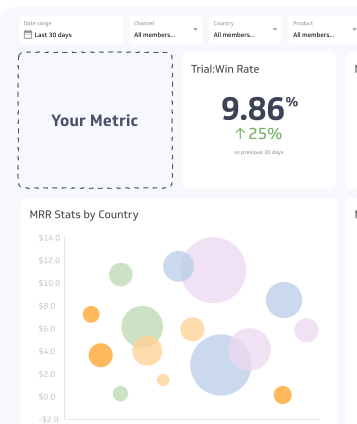
Use a summary chart to best visualize your Media Reach data. This type of chart compares the current Media Reach to a previous time period.
Reach vs. impressions: understanding the difference
These two metrics are closely related but measure different things. Confusing them leads to inflated performance claims and poor budget decisions.
| Metric | What it counts | Use case |
|---|
| Reach | Unique people exposed | Audience size, brand awareness |
| Impressions | Total exposures (including repeats) | Frequency, ad saturation |
| Frequency | Impressions / Reach | How often each person saw your content |
A campaign with high impressions but low reach is hitting the same people repeatedly. A campaign with high reach but low impressions may not be generating enough exposure per person to drive recall or action. The right balance depends on your campaign objective.
Why media reach matters
Reach is a foundational metric for brand awareness campaigns. It answers the most basic question in marketing: how many people did we actually get in front of?
Beyond awareness, reach informs:
- Budget allocation: Campaigns with low reach relative to spend may indicate poor targeting or audience saturation
- Channel comparison: Comparing reach across channels helps identify where your audience is most accessible
- Campaign scaling: If reach plateaus while impressions climb, your frequency is increasing — which may signal diminishing returns
- Creative testing: Holding reach constant while varying creative lets you isolate the effect of messaging
Reach is particularly important for new product launches, market expansion, and any campaign where building broad awareness is the primary goal.
Factors that affect reach
Several variables influence how far your content travels:
- Platform algorithm: Organic reach is governed by engagement signals, posting time, and content format. Video and interactive content typically achieves broader distribution
- Audience size: A larger follower base or broader targeting parameters increases potential reach, but targeting too broadly reduces relevance
- Budget: For paid campaigns, reach scales with spend up to the point of audience saturation
- Content quality and shareability: Content that earns shares, saves, or comments extends reach beyond your direct audience
- Posting frequency: Publishing more often can increase reach, but oversaturation may reduce per-post performance
Reach across different channels
Reach is measured differently depending on the channel, and definitions are not always consistent across platforms.
Social media: Platforms like Meta, LinkedIn, and TikTok report reach natively in campaign dashboards. Meta defines reach as the number of unique accounts that saw your content at least once. LinkedIn uses a similar definition for sponsored content.
Display and programmatic advertising: Reach is typically estimated using cookie or device ID data. Cross-device reach measurement remains a known challenge, and figures should be treated as approximations.
Television and radio: Traditional media uses reach differently — often expressed as a percentage of the total target audience (e.g., "reached 18% of adults 25–54"). This is sometimes called "rating points" and is measured through panel-based audience research.
Out-of-home (OOH): Reach for billboards and transit ads is estimated using traffic data and eye-tracking studies. These estimates carry higher uncertainty than digital channel figures.
Common mistakes when measuring reach
Double-counting across channels: Adding raw reach figures from multiple channels without accounting for audience overlap inflates total reach. Use integrated analytics tools or apply deduplication logic when combining channel data.
Confusing reach with impact: A large reach number does not mean the campaign was effective. Reach measures exposure, not engagement, recall, or conversion. Always pair reach with downstream metrics relevant to your campaign objective.
Ignoring frequency: Optimizing purely for reach can result in too-low frequency, where people see your message once and forget it. Most awareness campaigns require multiple exposures to drive recall. A frequency of 3–7 exposures is commonly cited as effective for brand recall, though this varies by category and creative quality.
Treating organic and paid reach as equivalent: Paid reach is purchased and targeted; organic reach is earned through content quality and algorithms. Mixing the two without distinction makes it harder to evaluate ROI.
Reach as part of a broader measurement framework
Reach is most useful when tracked alongside complementary metrics:
- Impressions — to calculate frequency and assess saturation
- Engagement rate — to understand how the reached audience responded
- Brand lift — survey-based measurement of awareness and recall among those reached
- Share of voice — how your reach compares to competitors in the same space
- Conversion rate — to connect top-of-funnel reach to bottom-of-funnel outcomes
Used in isolation, reach tells you how wide your net was cast. Combined with these metrics, it tells you whether the cast was worth it.