What is Reach per Million Users?
Reach per Million Users is the number of people, out of every million in Alexa's browser panel, who visited a website on a given day. It estimated how widely a site was seen, not how often, and marketers used it to track audience trends and compare their site with competitors. The data came from Alexa toolbar and extension users, so it was always a sample-based estimate. Amazon retired Alexa Internet on May 1, 2022, so the metric is no longer widely used.
Reach per Million Users Formula
How to calculate Reach per Million Users
Suppose you run a bakery blog, and yesterday Alexa's panel included 2,000,000 users. Of those, 1,000 visited your site.
- Divide visitors by panel size: 1,000 / 2,000,000 = 0.0005.
- Multiply by 1,000,000: 0.0005 × 1,000,000 = 500.
Your Reach per Million Users was 500. In plain terms, 1 in every 2,000 panel users stopped by for your sourdough tips. If the figure rose to 650 next month, more of the panel was finding you, even if your total visitor count in your own analytics told a different story.
Start tracking your Reach per Million Users data
Build and track this metric in PowerMetrics, a modern analytics platform that lets you define metrics and connect your own data.
Get PowerMetrics Free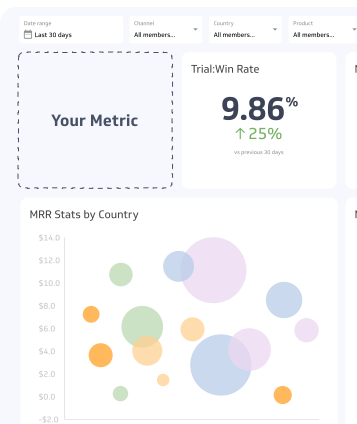
How to visualize Reach per Million Users?
Use a summary chart to best visualize your Reach per Million Users data. This type of chart compares the current value to a previous time period.
Reach per Million Users visualization example

Summary Chart
Here's an example of how to visualize your current Reach per Million Users data in comparison to a previous time period or date range.
More about Reach per Million Users
Why this metric is no longer widely used
Reach per Million Users depended on one data source, and that source no longer exists. Amazon retired Alexa Internet on May 1, 2022. Alexa's panel also had known limits:
- Skewed sample: Only people who installed the Alexa toolbar or extension were counted. They were not a representative cross-section of web users.
- Weak for small sites: Sites with little traffic produced noisy figures, because a few panel users could swing the result.
- Unverifiable: Alexa did not publish its weighting method, so you could not audit the numbers.
Used over time, it still showed direction for large sites. It was never a precise count.
How to interpret a result
A higher number means a larger share of the panel visited the site that day. Because the panel was a sample, read the number as a relative signal.
- Compare over time: A steady climb over several weeks suggested a growing audience. A single-day jump was usually noise.
- Compare against peers: Two sites measured by the same panel could be ranked against each other.
- Do not treat it as a visitor count: A Reach of 5,000 did not mean 5,000 people visited your site. It meant 5,000 per million panel users did.
What moved Reach up or down
Reach responded to anything that changed how many different people visited in a day:
- Campaigns and launches: Press coverage, paid campaigns, and email sends brought new people in.
- Search visibility: Ranking changes shifted how many new visitors arrived.
- Seasonality: Holidays, school terms, and industry events changed daily audiences.
- Panel composition: Changes in who used the toolbar could move the number without any change in your real audience.
Common pitfalls
- Confusing reach with traffic volume: Reach counted people once per day. Page views and sessions measured something else.
- Ignoring panel bias: The panel leaned toward certain user types, so results for niche or non-English audiences could mislead.
- Overreading small changes: Day-to-day moves were often sampling noise.
- Using stale figures: Any Reach number you find now is a historical record from 2022 or earlier. Do not use it to describe current performance.
Better alternatives today
Several measures answer the same question with more reliable data.
| Need | Use instead |
|---|---|
| Count of real visitors to your own site | Unique Users from your web analytics |
| Share of a target audience you reach | Audience reach from your ad or email platform |
| Comparison against competitors | A current panel-based traffic estimate, read as a relative trend |
First-party analytics give you exact counts for your own site. Panel-based estimates from current providers are still samples, so apply the same caution you would have applied to Alexa.
Related metrics
Reach per Million Users sits close to Unique Visitors, which counts distinct people in your own data, and to traffic rank, which ordered sites by combined reach and page views. Reach shows breadth of audience. To understand depth, pair it with engagement measures such as pages per session or time on site.
Reach per Million Users Frequently Asked Questions
What happened to Alexa Reach?
Amazon retired Alexa Internet on May 1, 2022. Alexa no longer publishes Reach, traffic rank, or search analytics, so the metric cannot be measured from its original source.
Is Reach per Million Users the same as unique visitors?
No. Unique Visitors counts distinct people in your own analytics. Reach per Million Users estimated how many people per million in Alexa's panel visited your site.