A business grows its subscriber base through blog content and social media promotions. After six months, 1,000 people have signed up through opt-in forms. The Email Contacts count is 1,000. That number tells the marketing team how many people they can reach with the next campaign.
Email Contacts
Last updated: Aug 26, 2026
What is Email Contacts?
Email Contacts is an email marketing metric that counts the total number of email addresses in an email list. A large, high-quality list helps marketers build ongoing relationships and reach more potential customers.
Email Contacts Formula
How to calculate Email Contacts
Start tracking your Email Contacts data
Build and track this metric in PowerMetrics, a modern analytics platform that lets you define metrics and connect your own data.
Get PowerMetrics FreeHow to visualize Email Contacts?
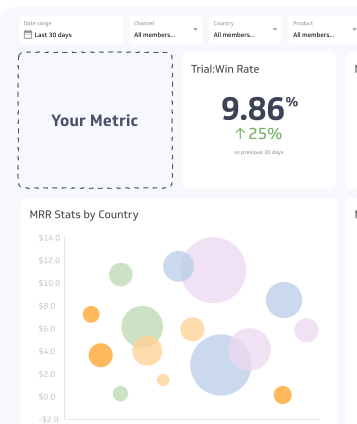
Use a line chart to view the change in count of email contacts over time, or a summary chart to compare the current value to a previous period. Check out the examples:
Email Contacts visualization examples
Email Contacts
Line Chart
Summary Chart
Email Contacts
Chart
Measuring Email ContactsMore about Email Contacts
Why Email Contacts matter
Email remains one of the most direct channels available to marketers. As of 2023, more than 4.3 billion people use email worldwide, a figure Statista projects will reach 4.8 billion by 2027. That reach rivals every major social platform, and unlike social media, your list is an asset you own outright.
A growing Email Contacts count means more potential readers, more clicks, and more opportunities to drive revenue. But size alone is not enough. A list of 10,000 disengaged contacts will underperform a focused list of 2,000 people who actively want your emails.
Quantity vs. quality
Both dimensions matter, and they pull in different directions if you are not careful.
Quantity increases your reach. More contacts means more chances for any given campaign to generate a click, a reply, or a purchase. Larger lists also provide more statistically reliable data when you run A/B tests on subject lines or send times.
Quality determines relevance. A contact who opted in because they genuinely wanted your content is far more likely to open, click, and convert than one added through a purchased list or a sweepstakes entry with no connection to your product.
Purchased lists are the most common quality trap. Contacts acquired that way have not consented to hear from you, which drives up email unsubscribes, damages sender reputation, and can trigger spam filters that affect deliverability for your entire list.
Organically grown lists, built through strategically placed sign-up forms, gated content, referral incentives, and social media, consistently outperform purchased ones because every contact has expressly opted in.
How to grow Email Contacts sustainably
A few practices reliably produce high-quality list growth:
Gated content: Offer a guide, template, or report in exchange for an email address. The contact self-selects based on genuine interest.
Embedded sign-up forms: Place forms at high-traffic points: homepage, blog posts, and checkout pages. Reduce friction by asking only for an email address at the first touchpoint.
Social media promotion: Drive followers to a dedicated landing page with a clear value proposition. Followers who convert to email subscribers tend to be your most engaged audience.
Referral incentives: Give existing contacts a reason to share your list with peers. Word-of-mouth additions carry strong intent signals.
Exit-intent prompts: Capture visitors who are about to leave with a timely, relevant offer.
Maintaining list health
List size naturally decays over time. People change jobs, abandon email addresses, or simply lose interest. Industry estimates suggest email lists lose roughly 22% of their contacts to decay each year (HubSpot, 2023). Without active maintenance, your Email Contacts count overstates your real reach.
Practices that preserve list quality:
Regular list cleaning: Remove hard bounces immediately and suppress contacts who have not engaged in 6 to 12 months.
Re-engagement campaigns: Before removing inactive contacts, send a targeted campaign asking them to confirm they still want to hear from you. Some will re-engage; the rest can be safely removed.
Double opt-in: Require new contacts to confirm their address. This reduces fake sign-ups and improves deliverability from the start.
Consistent send cadence: Irregular sending erodes familiarity. Contacts who forget why they subscribed are more likely to mark emails as spam.
Related metrics
Email Contacts does not tell the full story on its own. Track it alongside:
Email open rates: the percentage of contacts who open a given email. Low open rates on a large list often signal a quality problem.
Email click rates: the percentage of contacts who click a link. This measures engagement beyond the open.
Email unsubscribes: contacts who opt out. A rising unsubscribe rate is an early warning that list quality or email frequency needs attention.
Together, these metrics give a complete picture of whether your Email Contacts count is translating into real audience engagement.
Recommended resources related to Email Contacts
How to start an email marketing campaign.Here are some tips to build an Email Contact list.Contributor