Customer Acquisition Cost Ratio (CAC Ratio)

Last updated: Nov 28, 2025

What is Customer Acquisition Cost Ratio

Customer Acquisition Cost (CAC) Ratio is a sales and marketing efficiency metric that measures the return on investment from customer acquisition efforts. It calculates how many dollars of new subscription revenue (adjusted for gross margin) a company generates for each dollar spent on sales and marketing. Unlike simple revenue multiples, CAC Ratio accounts for the actual profit economics of delivering the service by incorporating gross margin, providing a more accurate picture of unit economics and capital efficiency.

Customer Acquisition Cost Ratio Formula

ƒ Sum(New logo and upsell bookings during the period) * Sum(Gross Margin) / Sum(Sales & marketing costs for the period)

How to calculate Customer Acquisition Cost Ratio

A SaaS company closes $500K in new subscription bookings during Q2 at an 80% subscription gross margin. In Q1 (prior quarter), they invested $400K in sales and marketing expense. CAC Ratio = ($500K × 0.80) / $400K = $400K / $400K = 1.0x This means the company generated $1 of subscription gross profit for every $1 invested in S&M. At this efficiency level, the company will eventually recoup its acquisition costs and generate profit from each customer, though payback period is still meaningful to track.

Start tracking your Customer Acquisition Cost Ratio data

Use Klipfolio PowerMetrics, our free analytics tool, to monitor your data.

Get PowerMetrics Free
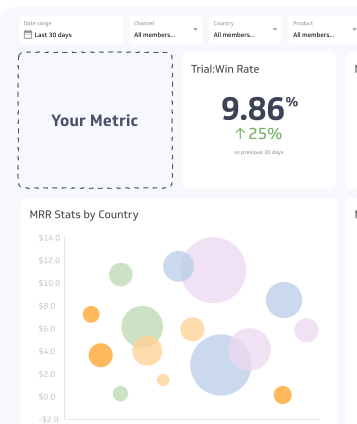
Klipfolio dashboard image

What is a good Customer Acquisition Cost Ratio benchmark?

1.0x is considered a healthy CAC Ratio benchmark, indicating that S&M investments are generating equivalent returns after accounting for delivery costs. Below 0.5x: Concerning efficiency; investigate whether product-market fit, sales process, or market conditions are problematic 0.5x - 0.75x: Acceptable for high-growth companies investing aggressively to capture market share, or during heavy hiring/ramping periods 0.75x - 1.0x: Good efficiency; balanced growth and profitability 1.0x - 1.5x: Excellent efficiency; strong product-market fit and mature go-to-market motion Above 1.5x: Outstanding efficiency, but verify you're not under-investing in growth opportunities Remember: CAC Ratio should be evaluated alongside growth rate. A 1.5x CAC Ratio with 20% growth may indicate under-investment, while 0.7x with 150% growth might be optimal.

How to visualize Customer Acquisition Cost Ratio?

CAC Ratio is usually expressed as a single-digit number so it would be optimal to visualize this metric with a summary chart. Summary charts compare current values to a previous time period.

Customer Acquisition Cost Ratio visualization example

Customer Acquisition Cost Ratio

2

arrow-right icon

0.53

vs previous period

Summary Chart

Here's an example of how to visualize your current Customer Acquisition Cost Ratio data in comparison to a previous time period or date range.
arrow-right icon
arrow-right icon

Customer Acquisition Cost Ratio

Chart

Measuring Customer Acquisition Cost Ratio

More about Customer Acquisition Cost Ratio

CAC Ratio illuminates the fundamental tradeoff between growth and efficiency that every SaaS company navigates. A company choosing rapid growth will hire aggressively, invest heavily in marketing, and onboard many unproductive reps who are still ramping—all of which temporarily depresses CAC Ratio. Conversely, slowing investment while existing reps mature can boost CAC Ratio but sacrifices growth velocity.

The "right" CAC Ratio depends heavily on context:

  • Market dynamics: Fast-growing markets and land-grab opportunities may justify lower CAC Ratios (0.6-0.8x) to capture market share before competitors
  • Competitive intensity: Highly competitive markets often require more spend per customer, pressuring CAC Ratio downward
  • Customer health: Strong economic conditions and healthy end-customer budgets enable more efficient selling (higher CAC Ratios)
  • Company stage: Early-stage companies often have lower CAC Ratios while establishing processes; mature companies should show consistent efficiency

Important Considerations:

  • Time lag matters: Sales and marketing investments take time to generate results. Best practice is to lag S&M expense by one quarter (some companies use 3-6 month lags depending on sales cycle length). This aligns investment with resulting bookings.
  • Expansion vs. new ARR: Most companies calculate CAC Ratio using only new customer ARR, not expansion revenue from existing customers, since expansion typically requires minimal S&M investment. However, define your approach consistently.
  • Gross margin calculation: Use subscription or SaaS gross margin specifically, excluding any low-margin services or hardware revenue that distorts the metric.
  • Investment cycles: Expect CAC Ratio to fluctuate with hiring cycles. Heavy sales hiring in Q1 might depress Q2 CAC Ratio as new reps ramp, then improve in Q3-Q4 as they reach productivity.

Customer Acquisition Cost Ratio Frequently Asked Questions

How does CAC Ratio differ from Magic Number, and when should I use each?

arrow-right icon

CAC Ratio and Magic Number measure similar concepts—sales and marketing efficiency—but with important differences:

CAC Ratio = (New ARR × Gross Margin) / Prior Quarter S&M Spend Magic Number = Net New ARR / Prior Quarter S&M Spend

Key differences:

  • Gross margin adjustment: CAC Ratio multiplies revenue by gross margin to reflect actual profit economics, while Magic Number uses raw revenue. This makes CAC Ratio more conservative and economically accurate—it shows true return after delivery costs.
  • Expansion revenue: Magic Number typically includes expansion ARR from existing customers (net new = new + expansion - churn), while CAC Ratio usually focuses only on new customer ARR. This makes Magic Number more holistic but CAC Ratio more targeted to acquisition efficiency.
  • Interpretation: A Magic Number of 0.75 might look acceptable, but if gross margin is 60%, the CAC Ratio would only be 0.45 (0.75 × 0.60)—revealing weaker unit economics.

When to use each:

  • CAC Ratio: Best for understanding true acquisition economics and unit-level profitability. Essential for board reporting, fundraising, and strategic planning where economic reality matters.
  • Magic Number: Better for operational tracking and quarter-over-quarter S&M efficiency trends, especially when you want to include expansion efficiency.

Best practice: Track both. Use Magic Number for operational dashboards and comparing total revenue productivity, but rely on CAC Ratio for economic decisions about scaling S&M investment.

Our CAC Ratio dropped from 1.2x to 0.7x after aggressive hiring. Is this bad, and when should we worry?

arrow-right icon

Not necessarily—this is often expected and strategic, but context determines whether it's healthy or concerning.

Why CAC Ratio drops during growth investments:

  1. Ramp time: New sales reps take 3-6 months to become productive. If you hired 10 reps in Q1, you're paying full salaries in Q1-Q2 but getting minimal output, suppressing Q2-Q3 CAC Ratio.
  2. Training costs: Onboarding investment (training, enablement, tools) hits immediately while results lag.
  3. Market development: Entering new segments or geographies requires upfront investment before revenue materializes.
  4. Marketing scale-up: Expanding campaigns or channels requires testing and optimization that depresses short-term efficiency.

When this is strategic and acceptable:

  • You're scaling deliberately to capture market opportunity
  • You can model and predict when CAC Ratio will recover (typically 2-3 quarters post-hiring)
  • Your cash runway supports the investment period
  • Cohort analysis shows reps eventually reach target productivity (1.0x+ CAC Ratio)
  • Growth rate is accelerating meaningfully (e.g., from 100% to 150% YoY)

When to worry:

  • CAC Ratio drops without corresponding growth acceleration
  • It's been 3+ quarters since hiring but ratio hasn't recovered
  • New rep cohorts aren't reaching historical productivity levels (indicates process or market problems)
  • You're burning cash faster than planned with no path back to efficiency
  • Churn is increasing, meaning even efficient acquisition won't generate returns

Action steps: Track CAC Ratio by cohort (new reps vs. mature reps) separately. If mature reps maintain 1.0x+ while new reps ramp, you're fine. If mature rep efficiency is declining, you have a fundamental problem beyond hiring—investigate market changes, competitive pressure, or sales process degradation.

Should CAC Ratio include all Sales & Marketing expenses, or can we exclude certain costs?

arrow-right icon

The standard definition includes all sales and marketing expenses, but there are legitimate debates about specific categories. Here's the breakdown:

Definitely include:

  • Sales salaries, commissions, and bonuses
  • Marketing salaries and agency costs
  • Advertising and paid acquisition spend
  • Sales tools and technologies (CRM, sales engagement, etc.)
  • Marketing tools and technologies (marketing automation, analytics, etc.)
  • Sales and marketing travel and events
  • Customer success costs related to pre-sale or onboarding activities

Gray areas (decide based on your business model):

Partner/channel costs:

  • Include if partners are a primary acquisition channel
  • Exclude if partners drive expansion/upsell but not new customers
  • Best practice: Track a separate "Partner CAC Ratio" if this is significant

Customer success/onboarding:

  • Include CS costs that occur during the sales process or directly enable closing deals
  • Exclude post-sale CS costs focused on retention and expansion
  • Draw the line at "contract signed"—pre-signature is S&M, post-signature is retention

Sales engineering/solutions architects:

  • Include if they're essential to closing deals (enterprise sales)
  • Some companies split: include pre-POC work in S&M, exclude post-POC delivery work

Why consistency matters more than perfection: The absolute value of CAC Ratio matters less than tracking it consistently over time. If you exclude partner costs in Q1, exclude them in Q2. The trend reveals efficiency improvements or deterioration.

Benchmark considerations: If you're comparing CAC Ratio to industry benchmarks or other companies, ensure you're using the same definition. When reporting to investors, explicitly state what's included (e.g., "CAC Ratio calculated using fully-loaded S&M including sales engineering, excluding post-sale customer success").

Recommendation: Default to including all S&M department costs for the most conservative, honest metric. If certain costs are highly variable or distorting (like a one-time conference), calculate both "reported CAC Ratio" (including everything) and "normalized CAC Ratio" (excluding anomalies) and explain the difference.