If 10 customers are paying $150 per month, then MRR would be: MRR = $1,500
If 7 customers are paying $200 per month, and 3 customers are paying $100 per month, then MRR would be: MRR = $1,700
Last updated: Jun 04, 2026
Monthly Recurring Revenue (MRR) is a key performance indicator (KPI) that represents the total predictable, recurring revenue a subscription-based business expects to generate every month from its active customers. It is calculated by normalizing all subscription income—regardless of the billing cycle (monthly, quarterly, or annual)—into a consistent monthly figure. MRR is a vital metric for Software-as-a-Service (SaaS) and other subscription models, providing an immediate and granular view of financial health, growth trajectory, and stability. Critically, MRR excludes all non-recurring revenue, such as one-time setup fees, consulting charges, or hardware sales, focusing solely on the reliable, repeatable income stream.
Alternate names: MRR, Recurring Revenue, Subscription RevenueIf 10 customers are paying $150 per month, then MRR would be: MRR = $1,500
If 7 customers are paying $200 per month, and 3 customers are paying $100 per month, then MRR would be: MRR = $1,700
Build and track this metric in PowerMetrics, a modern analytics platform that lets you define metrics and connect your own data.
Get PowerMetrics Free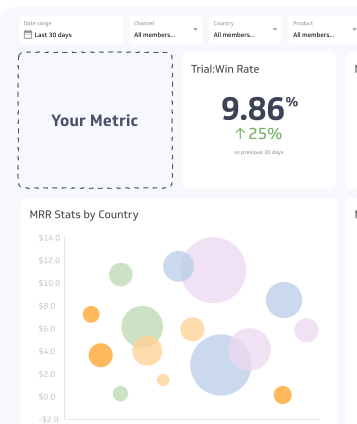
To visualize your Monthly Recurring Revenue, you can use a summary chart to display the value and optionally compare it to a previous time period.

Monthly Recurring Revenue
Monthly Recurring Revenue (MRR) is one of the most critical metrics for any business operating a subscription model, such as SaaS companies, media streaming services, or recurring membership platforms. It provides a standardized measure of a company’s baseline revenue, making it indispensable for financial planning, forecasting, and evaluating overall business momentum. By isolating the predictable, recurring portion of revenue, MRR offers a clearer signal of long-term stability and growth potential than total monthly revenue, which can be easily skewed by non-recurring charges or fluctuating sales.
The primary value of MRR lies in its ability to provide a clear, standardized, and timely assessment of business performance.
Financial Forecasting and Budgeting: A steady or growing MRR provides a reliable foundation for predicting future cash flows and setting realistic budgets. Consistent MRR allows business leaders to make informed decisions about resource allocation, hiring, and strategic investments.
Measuring Growth and Momentum: Tracking the month-over-month change in MRR offers a real-time barometer of the business’s health. It highlights whether the business is successfully acquiring new customers, retaining existing ones, and expanding their value.
Operational Insight: MRR is often segmented into different components to provide deeper operational insights. Analysing categories such as New MRR (from new customers), Expansion MRR (from upgrades or add-ons), Downgrade MRR (from customers moving to cheaper plans), and Churn MRR (from cancellations) helps identify the key drivers of revenue change. For instance, a high Expansion MRR suggests effective upselling and product value, while a high Churn MRR signals potential issues with customer satisfaction or retention.
Investor Confidence and Valuation: Although MRR is not a Generally Accepted Accounting Principle (GAAP) metric, it is heavily relied upon by investors, analysts, and stakeholders in the subscription economy. It is a vital component in determining a company’s valuation, as it quantifies the predictable revenue stream, which is highly valued.
Annual Recurring Revenue (ARR) is a related metric, essentially the annualized version of MRR.
The key difference is the timeframe and the typical application. MRR offers a granular, short-term view, which is essential for day-to-day operational management and quickly spotting the impact of recent changes, such as a new marketing campaign or pricing shift. Conversely, ARR provides a higher-level, long-term view, which is more suitable for multi-year contracts, annual financial reporting, long-range forecasting, and external communication with investors. Companies with a mix of monthly and multi-year contracts often track both.
To effectively track growth, most businesses focus on Net New MRR, which is the month-over-month change in recurring revenue. It is calculated by considering all the revenue movements within a month.
New MRR: Revenue generated from customers who are entirely new to the service.
Expansion MRR: Additional revenue from existing customers, typically through upgrades to higher-tier plans, purchase of add-ons, or increased usage of a variable pricing model. This is a strong indicator of customer success and product value.
Reactivation MRR: Revenue from customers who previously churned (cancelled their subscription) but have returned and re-subscribed.
Contraction MRR: Lost revenue from existing customers, primarily due to downgrades to a cheaper plan, applying discounts, or removing paid add-ons.
Churn MRR: Lost revenue from customers who fully cancel their subscription during the period.
These components are combined to calculate the overall Net New MRR:
Accurate and actionable MRR tracking requires adherence to specific best practices and an awareness of common pitfalls.
Normalization is Mandatory: All non-monthly subscription fees (annual, quarterly) must be divided by the number of months they cover to arrive at the true monthly recurring value. For example, a $1,200 annual contract contributes $100 to MRR each month.
Exclusion of Non-Recurring Revenue: One-time fees—such as implementation charges, set-up costs, or professional services fees—must be rigorously excluded from the calculation. Including non-recurring revenue artificially inflates MRR and compromises its value for forecasting.
Segment MRR: Breaking down MRR by product tier, customer segment (e.g., small business vs. enterprise), or geographic region provides richer context for strategic decisions. This segmentation helps in identifying which areas of the business are performing best and which require attention.
Integrate with Key Metrics: MRR is most powerful when analysed alongside other critical KPIs, such as Customer Acquisition Cost (CAC) and Customer Lifetime Value (CLV). This helps ensure the cost of acquiring customers justifies the recurring revenue they generate.
Miscalculating Non-Monthly Billing: A frequent error is failing to normalize annual or quarterly payments, which leads to overstating MRR in the month the payment is received. For example, incorrectly booking a $1,200 annual fee as $1,200 MRR in January instead of $100 MRR for each month of the year.
Including Non-Recurring Income: Improperly adding one-time fees (like a set-up fee or a consultation charge) or variable, non-guaranteed usage fees to the MRR figure distorts the metric.
Treating MRR as a GAAP Figure: MRR is a business-specific operational metric, not a formal accounting figure, and is therefore not regulated by GAAP or International Financial Reporting Standards (IFRS). It should not be confused with the actual revenue recognized on the income statement.
While total monthly revenue (often called Bookings or Billings) is essential for your accounting and tax compliance, MRR serves a distinct and vital role as a leading indicator of business health and future predictability. Total revenue includes non-recurring, one-off payments like setup fees, consulting charges, or hardware sales, which can fluctuate wildly and give a misleading sense of underlying stability. MRR deliberately filters out all non-recurring income, providing a normalized, pure measure of the income stream that you can reliably expect to receive month after month.
For a business leader, this predictability is crucial for accurate financial modelling and making strategic decisions, such as securing investment or planning hiring. The fact that MRR is normalized—meaning annual or quarterly payments are divided by the number of months they cover—further smooths out billing lumpiness, offering a clean, apples-to-apples comparison of performance from one month to the next. In short, total revenue tells you what you have earned, while MRR tells you what you can expect to earn.
MRR is an exceptional operational tool because its components directly map to different aspects of your customer and product strategy. Tracking the segmentation of your MRR—specifically Expansion MRR and Churn MRR—provides tangible data points for decision-making. If your Expansion MRR is consistently high, it suggests your upsell process, add-ons, and higher-tier products are effectively delivering value, which indicates strong product-market fit and a satisfied customer base willing to pay more. You should then look to double down on those successful expansion strategies.
Conversely, a rising Churn MRR or Contraction MRR signals a loss of customer value and requires immediate strategic attention. High churn may indicate product dissatisfaction, poor customer onboarding, or pricing misalignment. By analysing which customer segments or price tiers contribute most to Churn MRR, you can launch targeted initiatives such as enhanced customer success programmes or product fixes to improve retention and quickly recover lost recurring revenue. The granular nature of MRR makes it a critical driver for continuous improvement across the entire customer lifecycle.
