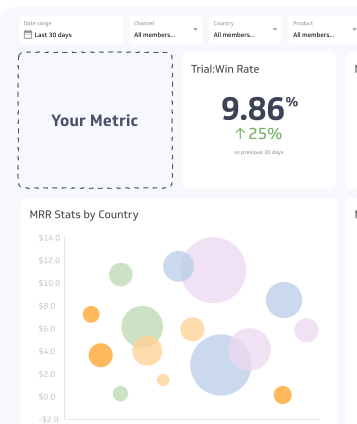
Opportunities is a count of qualified leads that have met a defined threshold of interest, fit, and intent, representing active potential revenue in the sales pipeline with a realistic chance of closing.
A SaaS company receives 200 inbound leads in a month. After applying its BANT qualification criteria, the sales team determines that 40 leads have confirmed budget, the right authority, a clear need, and a near-term timeline. Those 40 leads are created as opportunities in the CRM.
Opportunities = Count(Opportunity) = 40
The team now knows it has 40 active opportunities to work. If its historical win rate is 25%, it can expect roughly 10 closed-won deals from this cohort.
To visualize your Opportunities data, it may be helpful to add extra context by segmenting your data, perhaps by region or source. A pie chart can help you easily identify the most prominent segment.
Why opportunities matter
A pipeline full of unqualified leads produces inaccurate forecasts and wasted effort. Opportunities filter out noise and focus attention on deals that have a realistic chance of closing.
Tracking opportunity count over time helps sales leaders answer practical questions:
Is the pipeline growing? A declining opportunity count signals problems with lead generation or qualification.
Is conversion improving? Comparing opportunities to closed-won deals reveals how effective the sales process is.
Are targets achievable? When combined with average deal size and win rate, opportunity count feeds directly into revenue forecasting.
How to count opportunities
The formula is straightforward:
Opportunities = Count(Opportunity)
Each record that meets your qualification criteria counts as one opportunity. The definition of "qualified" varies by organization, but most sales teams use a structured framework to decide when a lead becomes an opportunity.
Common qualification frameworks include:
BANT (Budget, Authority, Need, Timeline)
MEDDIC (Metrics, Economic Buyer, Decision Criteria, Decision Process, Identify Pain, Champion)
CHAMP (Challenges, Authority, Money, Prioritization)
The specific framework matters less than applying it consistently. Inconsistent qualification inflates the opportunity count and distorts forecasting.
Opportunity stages
Most CRM systems organize opportunities into stages that reflect where a deal sits in the sales process. A typical stage progression looks like this:
| Stage | Description |
|---|
| Qualification | Lead meets initial criteria; opportunity created |
| Discovery | Needs and fit confirmed through conversation |
| Proposal | Pricing or solution presented |
| Negotiation | Terms under discussion |
| Closed-Won | Deal signed |
| Closed-Lost | Deal did not close |
Tracking opportunity count at each stage lets teams identify where deals stall and where the process needs improvement.
Leading and lagging context
Opportunity count is a leading indicator of revenue. It tells you what might close, not what has closed. That forward-looking quality makes it useful for forecasting but requires pairing with other metrics to tell the full story.
Metrics that work alongside opportunity count:
Win rate — the percentage of opportunities that close successfully
Average deal size — the expected revenue per closed opportunity
Sales cycle length — how long opportunities take to move from creation to close
Pipeline coverage ratio — the ratio of pipeline value to revenue target
Together, these metrics convert a raw opportunity count into a grounded forecast.
Common challenges
Inconsistent qualification criteria. When different reps apply different standards, the opportunity count becomes unreliable. Establish clear, shared criteria and reinforce them through CRM workflow and manager review.
Stale opportunities. Opportunities that sit in the pipeline without activity inflate the count and distort forecasting. Set a policy for when inactive opportunities are closed-lost or recycled.
Volume over quality. High opportunity counts can mask a weak pipeline if the underlying deals are poorly qualified. Monitor win rate alongside count to catch this pattern early.
CRM hygiene. Opportunity data is only as good as the records behind it. Missing fields, duplicate entries, and outdated stages all undermine the metric's value. Regular audits keep the data trustworthy.
Best practices
Define qualification criteria explicitly. Document what makes a lead an opportunity and make that definition visible to the whole sales team.
Review the pipeline regularly. Weekly or bi-weekly pipeline reviews catch stale deals before they distort forecasts.
Segment by source, rep, and stage. Aggregate counts are useful; segmented counts are actionable. Breaking down opportunities by origin or owner reveals where the pipeline is healthy and where it needs attention.
Connect to revenue targets. Use opportunity count with win rate and average deal size to calculate whether the pipeline can support the current quota.