Years Since Founding is a scale metric that counts the number of full years a company has been in operation, from its founding date to the current year.
Company A was founded in 2001 and Company B was founded in 2010. In 2025, Company A has been in business for 24 years and Company B for 15 years.
The formula is simply: Current Year minus Founding Year. So 2025 ? 2001 = 24, and 2025 ? 2010 = 15.
A higher number signals greater tenure, which can support brand credibility — particularly in trust-sensitive industries.
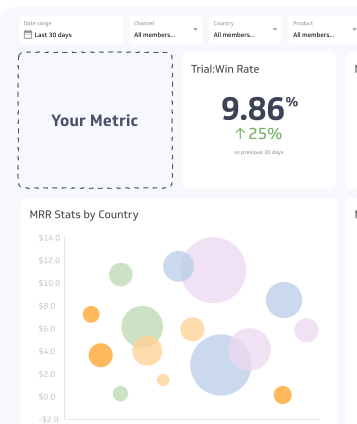
It is fairly simple to display your Years Since Founding number on a dashboard. Use a summary chart to display this number alongside other metrics like total funding, employee growth, and customer growth. A dashboard with all these metrics can display your company's achievements in a visual and informative way.
Why it matters
Longevity shapes perception. A company that has been operating for 20 years sends a different signal than one that launched last year, even if their products are comparable.
This effect is strongest in industries where trust is foundational:
- Financial services — Banks and insurers with long track records are perceived as lower risk
- Professional services — Consulting and legal firms use tenure to signal deep expertise
- Consumer products — Established brands benefit from familiarity and loyalty built over time
That said, longevity alone is not an advantage. Companies that fail to evolve with market conditions can find that age works against them, signalling stagnation rather than reliability.
How to use Years Since Founding
This metric is most useful as context, not as a standalone performance indicator. A few practical applications:
- Competitive positioning: Highlight tenure in marketing and sales materials when it reinforces trust with your target audience
- Investor reporting: Founders and executives sometimes include this as a framing metric in pitch decks or annual reports
- Benchmarking: When comparing companies in a cohort, filtering by years since founding helps control for maturity-related differences in revenue, headcount, and growth rate
For SaaS companies specifically, founding year can help contextualize metrics like Annual Recurring Revenue (ARR) growth and customer retention, since growth trajectories differ significantly between early-stage and mature businesses.
Balancing tenure with relevance
The reputational value of Years Since Founding depends on how well the company has kept pace with its industry. A 30-year-old brand that has modernized its product and positioning benefits from both credibility and relevance. One that has not may carry the weight of outdated perception.
Tracking this metric alongside brand sentiment, customer acquisition trends, and market share gives a more complete picture of whether tenure is an asset or a liability.