Growth in Valuation Since the Previous Raise is the percentage increase in a company's valuation from one funding round to the next. It shows how much value the company created between raises.
A company closes its Series A at a $20M valuation. Three years later, it raises a Series B at a $50M valuation.
Growth in Valuation = ($50M / $20M) - 1 = 1.5 = 150%
The company's valuation grew 150% between rounds. Whether that's strong depends on the time elapsed, the capital deployed, and the stage of the business.
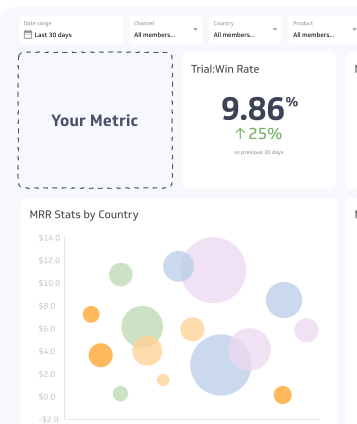
It is best to visualize growth metrics with line charts. Use a line chart to track your growth in valuation since the previous raise - perhaps adding notes indicating the details of the raise. This will let you quickly and easily see how raised capital has had an impact on your valuation. Take a look at the example:
Why this metric matters
Valuation growth between rounds is one of the clearest signals of capital efficiency. It answers a fundamental question: did the money raised actually build value?
A high growth rate suggests the company used its capital well — expanding revenue, improving margins, or strengthening its market position. A low or flat growth rate raises questions about how effectively the funding was deployed, even if the company is still operating.
This metric also shapes investor expectations. If valuation growth is strong, founders enter their next raise from a position of leverage. If it's weak, they may face a flat round or a down round, both of which carry reputational and dilution consequences.
Using this metric alongside other efficiency measures
Growth in Valuation Since the Previous Raise is most useful when read alongside capital efficiency metrics. Consider pairing it with:
- Burn Multiple: Compares net burn to net new ARR. A low burn multiple alongside strong valuation growth signals efficient scaling.
- Bessemer Efficiency Score: Measures how much ARR growth a company generates per dollar of net burn. Useful for benchmarking capital productivity.
Together, these metrics tell a coherent story about whether a company is growing its value in proportion to the capital it consumes. That story is central to any investor pitch.
What affects valuation between rounds
Valuation is not a single, clean number — it reflects a combination of factors that shift over time. Understanding what drives valuation growth helps founders track the right inputs.
Key drivers include:
- Revenue growth: ARR growth is the most direct lever for SaaS valuations, particularly at early and growth stages.
- Revenue quality: Metrics like net revenue retention, churn rate, and gross margin affect how investors value each dollar of revenue.
- Market conditions: Valuation multiples expand and contract with broader market sentiment, interest rates, and sector trends.
- Stage and comparables: A 150% valuation increase over five years reads differently than the same increase over eighteen months.
Because valuation is partly a negotiated outcome, two companies with identical fundamentals may receive different valuations depending on investor appetite and deal terms.
Common challenges and limitations
Time elapsed matters. A 100% valuation increase over two years is different from the same increase over six. Always consider growth in valuation relative to the time between raises and the capital deployed.
Valuations are not always comparable. Early-stage valuations can be speculative. If the previous round was priced in a hot market, the baseline may be inflated, making current growth look modest even if the business has genuinely improved.
Down rounds distort the picture. If a company raises at a lower valuation than its previous round, this metric turns negative. That context matters — a modest down round in a difficult market may reflect external conditions more than internal performance.
It is a lagging indicator. Valuation growth is confirmed at the point of a new raise, which may be years apart. Founders should track leading indicators — ARR growth, burn rate, gross margin — continuously rather than waiting for a new round to assess progress.