Customer Concentration
Last updated: Nov 29, 2025
What is Customer Concentration?
Customer Concentration measures the percentage of total revenue generated by a single customer or a group of top customers, revealing the company's dependency on key accounts and associated revenue risk. High concentration indicates that losing one or a few customers could significantly impact the business, while low concentration suggests a more diversified and resilient revenue base.
Customer Concentration Formula
How to calculate Customer Concentration
Scenario 1 - High Concentration Risk: Your SaaS business generates $3M in ARR annually. Your largest customer accounts for $1M of that revenue. Single Customer Concentration = ($1M / $3M) × 100% = 33.3% This is high-risk concentration. Losing this customer would eliminate one-third of revenue, likely requiring immediate cost cuts and potentially threatening business viability. You should implement measures to diversify revenue. Scenario 2 - Evaluating Top 5: Your company has $10M ARR with the following top customers: Customer A: $800K (8%) Customer B: $600K (6%) Customer C: $500K (5%) Customer D: $450K (4.5%) Customer E: $400K (4%) Top 5 Concentration = ($2.75M / $10M) × 100% = 27.5% This is within acceptable ranges for many businesses (target <25-30% for top 5), though you should monitor that no single customer grows to exceed 10%.
Start tracking your Customer Concentration data
Use Klipfolio PowerMetrics, our free analytics tool, to monitor your data.
Get PowerMetrics FreeWhat is a good Customer Concentration benchmark?
Concentration targets vary significantly by business model: SMB/Mid-Market SaaS (high volume, low ACV): Ideal: No single customer >1% of revenue Acceptable: No single customer >2-3% of revenue Top 10: <10-15% of revenue These businesses should have hundreds to thousands of customers providing natural diversification Enterprise/Large ACV SaaS (low volume, high ACV): Target: No single customer >10% of revenue Acceptable: No single customer >15% of revenue (temporarily) Top 5: <25-30% of revenue Top 10: <40-50% of revenue By Company Stage: Seed/Early ($0-2M ARR): <40% from top customer, <70% from top 5 (aspirational—often higher in reality) Series A ($2-10M ARR): <20% from top customer, <50% from top 5 Series B+ ($10M+ ARR): <10% from top customer, <30% from top 5 For M&A/IPO readiness: Most institutional investors and acquirers prefer <10% from the largest customer and <20% from top 5 customers, as higher concentration can trigger additional due diligence, valuation adjustments, or deal-breakers.
How to visualize Customer Concentration?
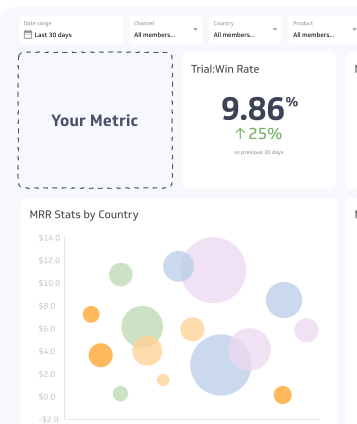
It makes most sense to use a summary chart to visualize customer concentration. This view will display your current customer concentration value which you can then compare to a value in the past.
Customer Concentration visualization example
Summary Chart
Customer Concentration
Chart
Measuring Customer ConcentrationMore about Customer Concentration
Customer Concentration (or Customer Revenue Concentration) quantifies how much of a company's total revenue depends on its largest customer(s). This metric is critical for assessing revenue risk and business stability. While some concentration is natural—and can even enable deeper customer relationships and focused resource allocation—excessive concentration creates vulnerability to customer churn, provides disproportionate leverage to key accounts in negotiations, and can negatively impact company valuation and attractiveness to investors or acquirers. The acceptable level of concentration varies significantly based on business model, customer segment (SMB vs. enterprise), and company maturity.
Risks of High Customer Concentration:
- Revenue volatility: Losing a single customer that represents 20%+ of revenue creates an immediate existential crisis and can trigger cash flow problems, layoffs, or inability to meet obligations.
Customer leverage: Large customers recognize their importance and may demand price concessions, custom features, extended payment terms, or preferential treatment that erodes margins and diverts resources. - Strategic constraints: Product roadmap and business strategy can become hostage to one customer's needs rather than broader market requirements, limiting scalability.
- Valuation impact: Investors and acquirers heavily discount businesses with high concentration (often applying 20-40% valuation haircuts), viewing them as higher risk. Many institutional investors have hard rules against investing in companies exceeding concentration thresholds.
- Exit complications: In M&A scenarios, acquirers often require representations about customer concentration and may place revenue in escrow or reduce purchase price if concentration is high.
Potential Benefits of Moderate Concentration (when managed carefully):
- Relationship depth: Fewer, larger customers enable stronger partnerships, better understanding of needs, and opportunity for strategic collaboration.
- Resource efficiency: Concentrated customer bases can be more cost-effective to serve and support than highly fragmented ones.
- Predictable revenue: Large enterprise contracts often have multi-year terms, providing revenue visibility (though creating concentration risk).
- Reference value: Marquee customers can serve as powerful case studies and sales tools for acquiring similar customers.
Context-Specific Considerations:
Early-stage startups (0-2 years, <$2M ARR):
- High concentration (30-50%+) is common and often unavoidable
- Focus on adding customers to diversify rather than losing existing ones
- Be transparent with investors about concentration and mitigation plans
- Use early large customers to establish product-market fit, then broaden
Growth-stage companies ($2-20M ARR):
- Should be actively managing concentration downward
- Target <20% from top customer, <50% from top 5
- Implement policies to prevent concentration from increasing
- May need to "fire" customers or cap their growth if they're growing faster than your business
Mature companies ($20M+ ARR):
- Should maintain <10% from any single customer
- <25-30% from top 5 customers
- Have formal concentration management policies in place
- Monitor concentration in real-time as part of business reviews
Important Considerations:
- Related entities: Count all revenue from related entities (subsidiaries, divisions of the same parent company) as a single customer for concentration purposes. Otherwise, you're hiding true concentration.
- Contract structures: Multi-year contracts with large customers reduce short-term churn risk but don't eliminate concentration risk—the customer may not renew.
- Industry dynamics: Some industries (e.g., government contracting, healthcare systems) naturally have larger customer sizes, making very low concentration harder to achieve.
- Geographic concentration: Also monitor geographic revenue concentration, as regional economic downturns can impact multiple customers simultaneously.
Customer Concentration Frequently Asked Questions
We have one customer representing 25% of revenue with a 3-year contract. Is this still risky, and what should we do?
Yes, this remains high-risk despite the contract protection, though the multi-year term provides time to address it. Here's why the risk persists and what to do:
Why contracts don't eliminate concentration risk:
- Renewal uncertainty: Even a 3-year contract eventually expires. If you remain at 25% concentration when renewal approaches, you'll have massive leverage imbalance in negotiations—the customer knows you can't afford to lose them and will extract concessions.
- Financial deterioration: If the customer faces financial distress, they may breach the contract, file bankruptcy (making your contract worth pennies on the dollar), or negotiate an early exit at reduced payment.
- Acquisition risk: If your customer is acquired, the new parent company may consolidate vendors, renegotiate contracts, or simply choose different solutions.
- Product/strategic misalignment: If the customer's needs diverge from your product direction over the contract term, they'll churn when it expires—and you may have optimized your roadmap for them at the expense of broader market fit.
- Exit implications: When raising capital or pursuing M&A, investors look at concentration at evaluation time, not "concentration if this contract renews." High concentration reduces valuation regardless of contract terms.
Action plan for managing 25% concentration:
Immediate (Months 1-6):
- Implement a formal "no customer >20%" policy for new sales
- Calculate your growth rate needed to naturally dilute this customer (if you grow revenue 50% while this customer stays flat, they become 16.7% instead of 25%)
- Diversify product roadmap to ensure you're not building exclusively for this customer
- Document the relationship risks and mitigation strategy for investors/board
Medium-term (Months 6-18):
- Aggressively pursue new customer acquisition to dilute concentration through growth
- Target customers in the same segment/size as your large customer to replicate success
- Consider whether to cap expansion revenue from this customer (e.g., politely decline additional seats or new products if it increases concentration)
- Develop alternate revenue streams or products that don't depend on this customer
Long-term (18+ months, before renewal):
- Aim to reduce concentration to <15% before the renewal negotiation begins
- Build relationships with economic buyers beyond your champion (reduce key person risk)
- Have a "plan B" if renewal fails—how would you cut costs and replace revenue?
- If still concentrated at renewal, negotiate hard but have realistic expectations about price pressure
Critical insight: Use the contract term as a runway to fix the problem, not as reassurance that there is no problem. The best time to reduce dependency is while you have contract protection, not after.
How do we balance concentration risk with the reality that enterprise customers are naturally larger? Can we ever reach <10% with a $50M ARR goal and $5M ACV deals?
This is a common tension in enterprise SaaS, and the answer is: yes, you can achieve <10% concentration even with large deals, but it requires deliberate customer acquisition strategy and realistic expectations about timeline.
The math of enterprise concentration:
If your Average Contract Value (ACV) is $5M and you target $50M ARR:
- At <10% concentration, no customer can exceed $5M—meaning your largest customer can be at most 1x ACV
- To maintain this, you need at least 10-15 customers in the $3-5M range
This is achievable but requires intentional growth strategy:
Strategy 1: Land-and-expand without over-expanding
- Start with smaller initial contracts ($500K-$1M) with enterprise customers
- Expand them over 2-3 years to $3-5M
- By the time they reach $5M, your company has grown to $75M+ ARR (keeping them at ~7%)
- Cap individual customer growth at $5M or implement gentle friction to slow expansion from largest customers
Strategy 2: Diversify customer acquisition channels
- Target multiple industries/verticals to avoid industry concentration compounding customer concentration
- Pursue different customer personas or use cases within large enterprises
- Balance large enterprise deals with mid-market customers ($500K-$2M ACV)
- Consider international expansion to access new large customer pools
Strategy 3: Revenue mix diversification
- Develop multiple products or modules that appeal to different buyers/departments
- Create different pricing tiers or editions (e.g., Professional vs. Enterprise vs. Ultimate)
- Some customers buy product A, others buy product B, others buy both—diversifying dependency
Realistic timeline expectations:
- Year 1-2: Early enterprise companies often have 40-60% concentration—this is normal
- Year 3-4: Should reach 20-30% concentration through customer additions
- Year 5+: Target <15% concentration, approaching <10% at scale
When high concentration is more acceptable in enterprise:
- Industry norms: In certain sectors (government contracting, aerospace, healthcare systems), 15-20% concentration from top customer is more acceptable
- Multiple stakeholders: If revenue comes from many divisions/departments of the same parent company with separate budgets and decision-makers, risk is partially mitigated (though still track it)
- Platform/infrastructure plays: If you become mission-critical infrastructure (like Salesforce or Snowflake were for early customers), renewal risk decreases
Practical example—Snowflake's journey: Snowflake had high concentration early (Capital One was >10% at IPO time) but:
- Disclosed it transparently to investors
- Showed strong trajectory of dilution through rapid customer acquisition
- Demonstrated the customer relationship was strategic and deeply integrated
- Still faced valuation pressure due to concentration
Bottom line: Don't accept high concentration as inevitable. Build a customer acquisition engine that can land 10-15 enterprise customers at scale. If you can only land 5-8 large customers in your TAM, you may not have a venture-scalable business—consider adjusting market focus or deal size.
Contributors