Post Reach is the count of unique people who saw your post at least once across a given time period. Unlike impressions, which tally every view including repeats, Post Reach measures how many distinct individuals your content actually reached. Marketers use it to evaluate content distribution, track audience exposure, and assess whether organic or paid amplification is expanding reach to new people.
Formula: Post Reach = Count of unique impressions
A social media manager at a growing e-commerce brand publishes a product announcement. Over one week, the post generates 4,200 total impressions. Of those, 3,100 come from unique accounts.
-
Total impressions: 4,200
-
Post Reach: 3,100
The remaining 1,100 impressions came from people who saw the post more than once. The manager now knows that 3,100 distinct people encountered the announcement — a baseline for comparing future posts and tracking audience exposure over time.
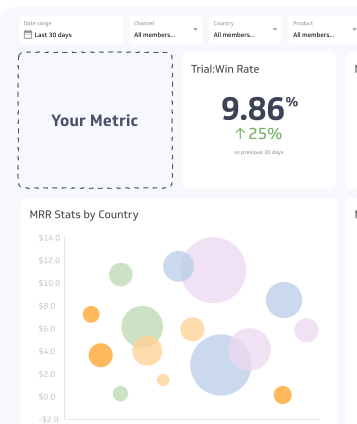
Use a summary chart to best visualize your Post Reach data. This type of chart compares the current value to a previous time period.
Why Post Reach matters
Post Reach answers a question that impressions alone cannot: how many people actually saw this? For content teams, Post Reach is a direct signal of distribution health. If reach is declining on organic posts, it often indicates a drop in algorithmic favour — the platform is showing the content to fewer unique accounts. If reach is growing, the content is spreading to new audiences through shares, discovery features, or paid promotion. For paid campaigns, reach is a critical efficiency metric. Advertisers use it alongside frequency (average impressions per person) to avoid over-exposing the same audience. High frequency with flat reach often means the campaign is spending budget on the same people rather than expanding its footprint.
Post Reach as a leading or lagging indicator
Post Reach is a lagging indicator. It reflects what already happened — how many people were exposed to a piece of content after it was published and distributed. That said, tracking reach trends over time gives it some predictive value. A consistent upward trend often signals that an account is building momentum: growing its follower base, improving algorithmic performance, or running effective paid campaigns. A sustained decline is an early warning that distribution is narrowing before follower counts or engagement rates visibly drop.
Common challenges with Post Reach
Platform differences in counting methodology: Not every platform defines a unique impression the same way. Meta counts a person once per day per post, meaning the same person can be counted on multiple days. LinkedIn and X use their own methodologies. When comparing reach across platforms, verify what each platform is actually measuring.
Organic vs. paid reach conflation: Many platforms report a combined reach figure that blends organic and paid exposure. Without separating these, it is difficult to know whether growth is coming from content quality or ad spend. Where possible, track organic reach and paid reach as separate metrics.
Reach without context is limited: A post that reached 10,000 people means very little without knowing the account's total audience size, the campaign objective, or how that figure compares to previous posts. Always interpret reach relative to a baseline or benchmark.
Reach can be gamed: Tactics like broad targeting, low-relevance boosting, or clickbait can inflate reach without delivering meaningful exposure to the right audience. High reach with low engagement rate or poor conversion downstream signals that the audience being reached is not the right one.
Best practices for tracking Post Reach
Segment by content type: Track reach separately for different formats — video, image, link posts, stories — to understand which formats distribute most effectively on each platform.
Monitor reach-to-engagement ratio: Divide engagement by reach to calculate your engagement rate. This ratio tells you how compelling the content was to the people who actually saw it. High reach with low engagement rate suggests the content is being distributed but not resonating.
Set a reach baseline before running paid campaigns: Know your organic reach benchmarks before adding paid amplification. This makes it possible to isolate the contribution of paid spend and assess whether it is delivering incremental reach or simply overlapping with your organic audience.
Track reach over time, not just per post: Individual post reach varies with timing, topic, and platform conditions. Aggregate reach trends across a week or month give a more reliable picture of whether your distribution is growing.
Related metrics
Post Reach is most useful when tracked alongside:
-
Impressions: The total number of times a post was displayed, including repeat views. Comparing impressions to reach reveals average frequency.
-
Engagement rate: Calculated as engagements divided by reach. A more meaningful measure of content effectiveness than raw engagement counts.
-
Follower growth rate: Reach that consistently exceeds your follower count suggests content is being discovered by non-followers — a positive signal for organic growth.
-
Frequency: Average number of times a unique person saw the post (impressions divided by reach). Useful for managing ad fatigue in paid campaigns.