Return on Invested Capital is a profitability metric that measures how efficiently a company generates profit from its deployed capital. It is calculated by dividing Net Operating Profit After Tax (NOPAT) by invested capital and expressed as a percentage.
A manufacturing company ends the year with NOPAT of $3M and invested capital of $18M.
ROIC = $3M / $18M = 16.7%
If the company's weighted average cost of capital (WACC) is 9%, ROIC exceeds WACC by 7.7 percentage points — indicating the company is generating real economic value from its capital base.
ROIC above 10–15% is considered strong across most industries. Sustained ROIC above 20% typically signals a durable competitive advantage. The most meaningful threshold is whether ROIC exceeds the company's weighted average cost of capital (WACC); falling below WACC over time indicates value destruction. Benchmarks vary significantly by industry and capital intensity.
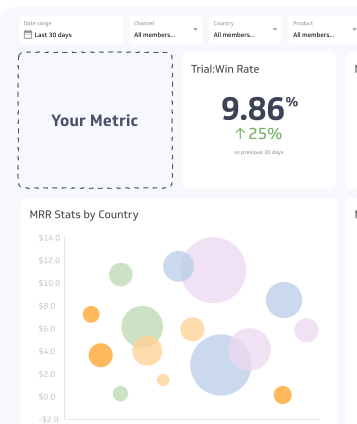
When tracking your ROIC data on a dashboard, it's optimal to visualize your data in a summary chart. This chart displays your ROIC as a current value which you can then compare to a previous time period.
What is Return on Invested Capital?
Return on Invested Capital is a profitability metric that shows how much net operating profit a company generates for every dollar of capital invested in the business. It is calculated by dividing Net Operating Profit After Tax (NOPAT) by invested capital and is expressed as a percentage.
ROIC differs from metrics like Return on Equity (ROE) or Return on Assets (ROA) because it focuses specifically on capital that has been actively deployed, stripping out cash and non-operating assets. This makes it a cleaner measure of operational efficiency.
How to calculate ROIC
The formula is straightforward, but the inputs require care.
NOPAT is operating profit adjusted for taxes, excluding interest expense. It reflects the earnings the business generates from its core operations before financing decisions affect the result.
Invested capital represents the total capital deployed in the business. It is typically calculated as total assets minus non-interest-bearing current liabilities and excess cash. Alternatively, it can be derived from the financing side as total debt plus total equity minus excess cash.
Consistency matters here. Use the same definition of invested capital across periods so that trend comparisons remain valid.
Why ROIC matters
ROIC is a capital efficiency metric. It answers a fundamental question: is this business a good steward of the money entrusted to it?
When ROIC consistently exceeds the cost of capital, the company is compounding value. When ROIC falls below the cost of capital, growth actually destroys value — the company is deploying capital at a loss relative to what investors expect.
This is why ROIC is especially useful when evaluating growth decisions. A company can grow revenue rapidly while still destroying shareholder value if the returns on new investments are insufficient. ROIC surfaces that tension directly.
ROIC also enables comparison across companies and industries. Because it neutralizes the effect of capital structure (debt vs. equity), it provides a more level comparison than metrics that are sensitive to leverage.
ROIC vs. WACC: the value creation threshold
The relationship between ROIC and WACC is the core of value creation analysis.
| Relationship | Interpretation |
|---|
| ROIC > WACC | Company is creating economic value |
| ROIC = WACC | Company is breaking even on capital deployed |
| ROIC < WACC | Company is destroying economic value |
A common rule of thumb is that ROIC should exceed 2% as a minimum threshold, but the more meaningful benchmark is whether ROIC clears the company's own WACC. A 5% ROIC is strong if WACC is 3%; it is inadequate if WACC is 8%.
Benchmarks and industry context
ROIC varies significantly by industry, capital intensity, and business model. Capital-light businesses — software, consulting, asset-light platforms — can sustain higher ROIC because their invested capital base is small relative to earnings. Capital-intensive industries — utilities, manufacturing, infrastructure — tend to operate at lower ROIC because large asset bases are required to generate revenue.
As a general benchmark, an ROIC above 10–15% is considered strong across most industries. Sustained ROIC above 20% is exceptional and typically signals a durable competitive advantage. An ROIC below the company's WACC, sustained over time, is a red flag regardless of revenue growth.
Always qualify benchmarks against the relevant sector and business model before drawing conclusions.
Tracking ROIC over time
A single ROIC figure is informative, but the trend is more valuable. Rising ROIC over multiple periods suggests improving capital efficiency, stronger pricing power, or better asset utilization. Declining ROIC may indicate increasing competition, deteriorating margins, or capital allocation decisions that are not paying off.
To assess the quality of future capital deployment — rather than historical returns — track Return on Incremental Invested Capital alongside ROIC. Return on Incremental Invested Capital focuses on the returns generated by new capital deployed in a given period, which is a leading indicator of whether recent investment decisions will create value.
Common challenges
Defining invested capital consistently. Different analysts define invested capital differently. Some include goodwill and intangibles; others exclude them. The choice affects the result materially. Document your definition and apply it consistently.
Operating lease adjustments. Under current accounting standards, operating leases appear on the balance sheet. Depending on your analysis, you may need to adjust invested capital to include or exclude capitalized lease obligations for comparability.
One-time items in NOPAT. Unusual charges or gains can distort NOPAT in a given period. Normalizing for one-time items gives a more accurate picture of sustainable operating performance.
Goodwill and acquisitions. Companies that grow through acquisition carry goodwill on their balance sheets, which inflates invested capital and suppresses ROIC. Comparing pre- and post-acquisition ROIC, or calculating ROIC with and without goodwill, reveals whether acquisitions are generating adequate returns.