Purchases is the total amount spent on goods bought from suppliers for the purpose of reselling at a profit. It records procurement spend at the time of purchase, before inventory adjustments or labour costs are applied.
A bakery supply shop places Q1 orders totalling $3,200 in baking equipment, $1,400 in branded packaging, and $2,600 in dry ingredients for resale.
Total Purchases = $7,200.
If the supplier issues a $300 credit for a returned item,
Net Purchases = $6,900.
Purchases = Sum of all amounts paid to suppliers and vendors
In practice, this means adding up every invoice paid to external suppliers for goods intended for resale during a given period.
For a more precise view of net inventory additions, many businesses use:
Net Purchases = Purchases – Purchase Returns – Purchase Discounts + Freight-In
This adjusted figure accounts for returned goods, supplier discounts, and the cost of getting inventory to your location.
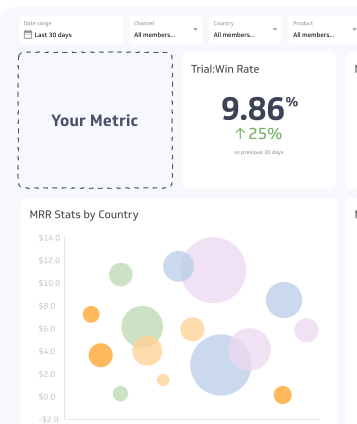
It's pretty straightforward to track your Purchases data. Your aim is to display the number, expressed as a dollar (or other currency) amount, perhaps segmented by expense type. A summary chart is a basic yet useful view for metrics like Purchases. Take a look at the example to get an idea of how to visualize your Purchases data:
How purchases differ from Cost of Goods Sold
Purchases and Cost of Goods Sold (COGS) are related but measure different things at different points in the business cycle.
Purchases records the cost of inventory at the time you buy it from a supplier. COGS records the cost of inventory at the time you sell it, and also factors in additional costs such as labour and overhead.
| | Purchases | COGS |
|---|
| When recorded | At time of purchase | At time of sale |
| Includes labour? | No | Yes |
| Scope | Supplier and vendor payments only | Full cost of producing or delivering goods sold |
This distinction matters for financial reporting. A business can have high purchases in a period while COGS remains lower if that inventory hasn't moved yet.
Why tracking purchases matter
Purchases is a foundational input for several key financial metrics and processes:
- Inventory valuation: Purchases feed directly into your ending inventory calculation, which affects your balance sheet.
- COGS calculation: Under a periodic inventory system, COGS is derived using beginning inventory, purchases, and ending inventory.
- Cash flow planning: Monitoring purchases helps finance teams anticipate outflows and manage working capital.
- Supplier spend analysis: Aggregating purchases by vendor reveals concentration risk and negotiation opportunities.
Purchases in periodic vs. perpetual inventory systems
How you record purchases depends on the inventory system your business uses.
Periodic inventory system: Purchases are tracked in a dedicated "Purchases" account throughout the period. At the end of the period, COGS is calculated by adjusting for opening and closing inventory. This approach is common in smaller businesses.
Perpetual inventory system: Each purchase updates inventory records in real time. There is no separate "Purchases" account; instead, the inventory asset account increases with each transaction. This approach is standard in businesses using point-of-sale or ERP systems.
Understanding which system applies to your business is important before interpreting any purchases figure.
Common challenges
Timing mismatches: Purchases recorded in one period may relate to inventory sold in another. This can distort period-over-period comparisons if not accounted for carefully.
Purchase returns and allowances: Gross purchases figures can overstate actual spend if returns and supplier credits aren't tracked and deducted.
Freight and landed costs: Some businesses exclude inbound freight from purchases, which understates the true cost of acquiring inventory. Consistent treatment of freight-in is essential for accurate comparisons.
Invoice timing vs. receipt timing: In accrual accounting, the purchase should be recorded when the goods are received, not when the invoice arrives. Misalignment here can affect both the income statement and balance sheet.