A company has a share price of $100 and earnings per share (EPS) of $5. P/E Ratio = $100 / $5 = 20. This means investors are paying $20 for every $1 of earnings. Whether that is attractive depends on the company's growth prospects and how that multiple compares to industry peers.
Price-to-Earnings Ratio (P/E Ratio)
Last updated: Jun 19, 2026
What is Price-to-Earnings Ratio?
The Price-to-Earnings Ratio is a company valuation metric that compares a stock's current share price to its earnings per share, showing how much investors pay for each dollar of earnings.
Alternate names: Price Multiple, Earnings MultiplePrice-to-Earnings Ratio Formula
ƒ Market Value Per Share / Earnings Per Share
How to calculate Price-to-Earnings Ratio
Start tracking your Price-to-Earnings Ratio data
Build and track this metric in PowerMetrics, a modern analytics platform that lets you define metrics and connect your own data.
Get PowerMetrics Free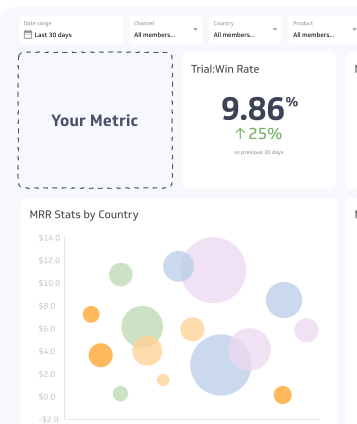
What is a good Price-to-Earnings Ratio benchmark?
As a general reference, a P/E Ratio below 15 is often considered low (potentially undervalued), while a ratio above 20–25 is considered elevated. However, these thresholds vary significantly by sector. Technology and growth stocks routinely trade at P/E ratios of 30 or higher, while utilities and financial stocks often trade in the 10–15 range. The S&P 500's long-run average P/E is approximately 16–17, though it has frequently exceeded 20–25 during periods of low interest rates and strong growth expectations (source: Shiller P/E data, Yale, 2024). Always compare P/E within the same sector and against the company's own historical range for meaningful context.
How to visualize Price-to-Earnings Ratio?
The P/E Ratio is best represented as a single dollar value, easy for you to refer to and have this number at your fingertips. Take a look at the example summary chart for one way to visualize your P/E Ratio data:
Price-to-Earnings Ratio visualization example

Summary Chart
Here's an example of how to visualize your current Price-to-Earnings Ratio data in comparison to a previous time period or date range.

Price-to-Earnings Ratio
Chart
Measuring Price-to-Earnings RatioMore about Price-to-Earnings Ratio
Trailing vs. forward P/E
The P/E Ratio comes in two main forms, and the distinction matters.
Trailing P/E uses actual reported earnings from the past 12 months. It is the standard form of the ratio and is considered more reliable because it is based on known data.
Forward P/E uses projected earnings for the next 12 months. It is more speculative but useful when evaluating a company expected to grow rapidly. Forward P/E is often lower than trailing P/E for high-growth companies, reflecting anticipated earnings increases.
| Type | Earnings used | Best for |
|---|---|---|
| Trailing P/E | Last 12 months (actual) | Established companies with stable earnings |
| Forward P/E | Next 12 months (estimated) | Growth companies or cyclical businesses |
When analysts reference "the P/E Ratio" without qualification, they typically mean trailing P/E.
How to interpret the P/E Ratio
P/E interpretation is context-dependent. There is no single number that is universally good or bad.
High P/E: Can indicate that a stock is overvalued, or that investors expect strong future growth. Technology and growth stocks often carry high P/E ratios because the market is pricing in future earnings, not just current ones.
Low P/E: Can indicate that a stock is undervalued and represents a buying opportunity, or that the company faces challenges and the market has discounted its prospects accordingly.
Negative P/E: Occurs when a company reports a net loss. A negative P/E is generally not meaningful for comparison purposes.
The P/E Ratio is most useful when compared against:
The company's own historical P/E to assess whether the current valuation is high or low relative to its own track record
Industry peers to understand sector norms (technology companies typically trade at higher multiples than utilities)
Broad market benchmarks such as the S&P 500's average P/E to gauge relative value
Common challenges and limitations
The P/E Ratio is powerful but has real limitations that investors should account for.
Earnings can be manipulated. Because EPS is an accounting figure, it is subject to one-time items, write-downs, and accounting choices that distort the ratio. Adjusted or normalized earnings figures can help, but introduce their own subjectivity.
It ignores debt. Two companies with identical P/E ratios may have very different capital structures. A heavily indebted company carries more risk than a debt-free peer, but the P/E Ratio does not reflect this. Metrics like the EV/EBITDA ratio can complement P/E analysis by accounting for debt.
It is not useful for loss-making companies. Startups and companies in turnaround situations often report negative earnings, making P/E meaningless. Price-to-Sales (P/S) or Price-to-Book (P/B) ratios are more appropriate in these cases.
Sector comparability is limited. Comparing the P/E of a bank to that of a software company is rarely informative. Always compare within the same industry or sector.
Best practices for using the P/E Ratio
Use it alongside other valuation metrics. Pair P/E with EV/EBITDA, Price-to-Book, and Price-to-Sales for a more complete picture.
Adjust for growth. The PEG Ratio (P/E divided by earnings growth rate) accounts for growth expectations and can make high-P/E growth stocks more comparable to lower-growth peers.
Normalize for cycles. The Cyclically Adjusted P/E (CAPE or Shiller P/E) averages earnings over 10 years to smooth out economic cycles, offering a longer-term valuation perspective.
Track it over time. A company's P/E relative to its own history is often more informative than a single snapshot.
Price-to-Earnings Ratio Frequently Asked Questions
What is a good P/E Ratio?
There is no single good P/E Ratio. A ratio below 15 is generally considered low, while above 20–25 is considered elevated, but norms vary widely by sector. Technology stocks routinely trade at higher multiples than utilities or financials. Always compare a company's P/E to its industry peers and its own historical range.
What is the difference between trailing P/E and forward P/E?
Trailing P/E uses actual earnings from the past 12 months and is the standard form of the ratio. Forward P/E uses projected earnings for the next 12 months. Trailing P/E is more reliable; forward P/E is more useful for evaluating high-growth companies where future earnings are expected to be significantly higher than current ones.
Can the P/E Ratio be negative?
Yes. A negative P/E occurs when a company reports a net loss, making earnings per share negative. A negative P/E is not meaningful for valuation comparison and is typically excluded from analysis. Alternative metrics such as Price-to-Sales or Price-to-Book are more useful for loss-making companies.
Contributor