EV/EBITDA is a valuation ratio that compares a company's enterprise value to its EBITDA, used to evaluate acquisition targets and compare companies across industries and geographies.
A company has a market capitalization of $50M, total debt of $1M, and cash of $400K. Its EBITDA for the trailing twelve months is $5M.
Enterprise Value = $50M + $1M ? $0.4M = $50.6M
EV/EBITDA = $50.6M / $5M = 10.12x
A result of 10.12x means an acquirer would pay roughly $10.12 for every $1 of operating earnings. Whether that represents fair value depends on the industry and the company's growth profile.
There is no universal benchmark for EV/EBITDA. Acceptable ranges vary by industry, company size, and market conditions:
- Below 10x — common in mature, capital-intensive industries such as utilities, manufacturing, and energy
- 10x–20x — typical for stable, profitable businesses in consumer goods, healthcare, and industrials
- Above 20x — common in high-growth technology and software companies
Always compare against direct industry peers and recent comparable transactions rather than a fixed threshold.
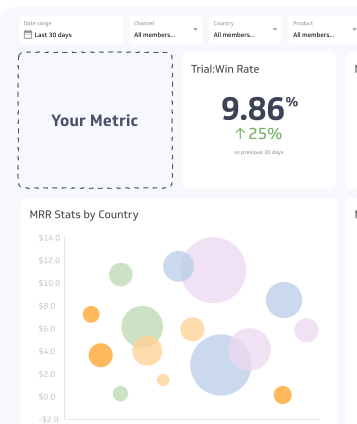
Represent your EV/EBITDA as a summary chart or metric chart on your dashboard. This will give you the maximum visual impact by displaying the current value in comparison with a previous time period. Take a look at the example:
EV/EBITDA is the ratio of a company's enterprise value to its earnings before interest, taxes, depreciation, and amortization. It tells investors how many dollars of enterprise value exist for every dollar of operating earnings.
Enterprise Value (EV) represents the total cost to acquire a business. It combines market capitalization with debt, then subtracts cash and cash equivalents. EBITDA strips out financing decisions, tax environments, and non-cash charges to isolate earnings from core operations.
Why EV/EBITDA matters
EV/EBITDA is one of the most widely used valuation multiples in mergers and acquisitions, private equity, and equity research. It matters for several reasons.
It neutralizes capital structure differences. Because EBITDA sits above interest expense, the ratio is unaffected by how a company finances itself. A heavily leveraged firm and a debt-free firm can be compared on equal footing.
It adjusts for tax environment. Companies operating in different countries face different tax rates. By using pre-tax earnings, EV/EBITDA allows cross-border comparisons without distortion from local tax regimes.
It removes non-cash charges. Depreciation and amortization policies vary widely, especially between capital-intensive and asset-light businesses. Excluding these charges makes comparisons more consistent.
It anchors acquisition pricing. Buyers use EV/EBITDA to benchmark deal prices against comparable transactions and to stress-test how much they are paying per dollar of earnings.
How to interpret EV/EBITDA
A lower multiple generally signals that a company is undervalued relative to its earnings, which can indicate lower acquisition risk. A higher multiple suggests the market expects stronger future growth, or that the business carries a premium for brand, competitive position, or scarcity.
Neither a high nor a low multiple is inherently good or bad. Context matters:
| Signal | Possible interpretation |
|---|
| Low EV/EBITDA | Undervalued stock, value opportunity, or declining business |
| High EV/EBITDA | High-growth expectations, strong competitive moat, or overvaluation |
| Negative EBITDA | Ratio is not meaningful; use alternative metrics |
The most important reference point is the industry median. A multiple that looks high in one sector may be typical in another.
Common variations and limitations
Trailing vs. forward EV/EBITDA. Trailing EV/EBITDA uses the last twelve months of reported EBITDA. Forward EV/EBITDA uses projected EBITDA for the next twelve months. Forward multiples are more relevant when a company is growing rapidly, but they depend on forecast accuracy.
Adjusted EBITDA. Many companies report adjusted EBITDA that excludes one-time items such as restructuring charges, stock-based compensation, or acquisition costs. Adjusted figures can make comparisons cleaner, but they also introduce subjectivity. Always confirm what is included or excluded before comparing across companies.
Not suitable for all business types. EV/EBITDA is less meaningful for:
- Financial services firms, where interest income and expense are core to the business model
- Early-stage companies with negative EBITDA
- Real estate businesses, where depreciation is economically significant and should not be excluded
In these cases, alternative multiples such as Price-to-Book, Price-to-Earnings, or sector-specific metrics are more appropriate.
EV/EBITDA in practice
Analysts and investors use EV/EBITDA at several stages of the investment and acquisition process.
Screening. When scanning a universe of companies, EV/EBITDA provides a fast filter for identifying potentially undervalued or overvalued businesses relative to peers.
Comparable company analysis (comps). Investment banks and private equity firms build comps tables that list EV/EBITDA multiples for a set of similar public companies. These tables anchor valuation ranges for private transactions or IPO pricing.
Precedent transaction analysis. M&A advisors look at EV/EBITDA multiples paid in prior deals within the same sector to establish a market-based reference for deal pricing.
Valuation sanity check. Even when a discounted cash flow model drives primary valuation, EV/EBITDA serves as a cross-check. A DCF result that implies a multiple far outside the industry range warrants scrutiny.
EV/EBITDA vs. P/E ratio
EV/EBITDA and the Price-to-Earnings (P/E) ratio are both valuation multiples, but they measure different things and serve different purposes.
| EV/EBITDA | P/E ratio |
|---|
| Numerator | Enterprise Value (debt + equity ? cash) | Market capitalization (equity only) |
| Denominator | Pre-tax, pre-interest, pre-D&A earnings | Net income (after all deductions) |
| Capital structure | Neutral | Sensitive to leverage |
| Tax environment | Neutral | Sensitive to tax rates |
| Best for | M&A, cross-border comparisons | Public equity screening |
EV/EBITDA is generally preferred for acquisition analysis because it reflects the full cost of ownership, including assumed debt. P/E is more common in public equity contexts where investors are focused on equity returns.