Non-operating expenses are the sum of all costs unrelated to a company's core business operations, such as interest payments, asset disposal losses, foreign exchange losses, restructuring charges, and one-time write-downs. These expenses are typically non-recurring and do not arise from day-to-day business activities.
A clothing export company sells a warehouse it no longer needs. The building was purchased for $800,000 and sold for $500,000.
Formula: Non-Operating Expenses = Sum of all non-operating costs
Loss on asset disposal = $800,000 ? $500,000 = $300,000
This $300,000 is recorded as a non-operating expense. It does not reflect the company's ability to sell clothing — it reflects a one-time financial event. Reporting it separately keeps operating results clean and comparable across periods.
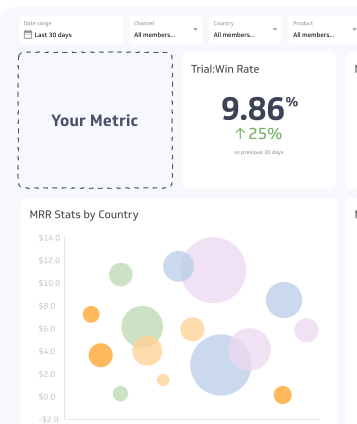
It is sufficient to visualize your Non-Operating Expenses as a summary chart. This type of chart compares your current value to a previous time period.
Core business operation costs — such as salaries, rent, and marketing — arise from the day-to-day activities required to run a business. These costs must generate profit to justify the expense.
Non-operating expenses are financial obligations that fall outside core business operations. Common examples include interest payments, losses from selling assets, foreign exchange losses, restructuring charges, impairment write-downs, and legal settlements.
Where they appear on the income statement
Non-operating expenses sit below the operating profit line on the income statement. This placement lets readers assess core business profitability — through metrics like EBITDA or operating income — before factoring in costs that fall outside normal operations.
| Line item | Description |
|---|
| Revenue | Total sales from core operations |
| Operating expenses | Day-to-day costs: salaries, rent, marketing |
| Operating profit (EBITDA) | Revenue minus operating expenses |
| Non-operating expenses | Interest, asset losses, restructuring, etc. |
| Net income | Operating profit minus non-operating expenses |
Non-operating expenses vs. operating expenses
Operating expenses are the costs required to run the business day-to-day: wages, rent, utilities, and marketing. They recur regularly and directly support revenue generation.
Non-operating expenses do not support ongoing revenue. They arise from financing decisions, one-time events, or external factors. Mixing the two distorts the picture of how efficiently a business runs.
Why non-operating expenses matter
Separating non-operating expenses from operating costs gives a cleaner view of business performance. A company with strong operating profit but high non-operating expenses may still appear unprofitable at the net income level — not because the core business is struggling, but because of debt costs or a one-time write-down.
Some non-operating expenses, like interest, are tax-deductible, which can lower a company's effective tax rate. This makes the financing mix — how much debt versus equity a company uses — a meaningful factor in overall profitability.
Red flags and misuse
High or growing non-operating expenses warrant scrutiny. Recurring "one-time" charges can signal underlying operational problems being obscured by reclassification. Analysts look for:
Frequency: Truly non-recurring expenses should not appear every quarter
Magnitude: Large non-operating charges relative to operating profit can distort net income significantly
Disclosure quality: Vague descriptions of non-operating items make it harder to assess their nature and likelihood of recurrence
Best practices for tracking non-operating expenses
Categorize consistently: Use a clear, consistent chart of accounts to separate operating from non-operating items. Inconsistent categorization makes trend analysis unreliable.
Review regularly: Even non-recurring items benefit from periodic review. Patterns in "one-time" costs often reveal systemic issues.
Disclose clearly: In financial statements and management commentary, explain the nature of significant non-operating charges. Transparency builds credibility with investors and lenders.
Adjust for analysis: When calculating metrics like EBITDA or adjusted earnings, document which non-operating items you are excluding and why. Consistency in adjustments matters for comparability.



.jpg)