A software company reports the following for Q3: Revenue of $2,000,000; COGS of $400,000; Operating Expenses of $700,000; Taxes of $150,000; Interest Expenses of $50,000. Net Income = $2,000,000 - $400,000 - $700,000 - $150,000 - $50,000 = $700,000. The company retained $700,000 in profit after covering all costs. That figure flows to retained earnings or is distributed to shareholders.
Net Income
Last updated: Aug 14, 2026
What is Net Income?
Net Income is the profit remaining after subtracting all expenses, including COGS, operating costs, taxes, and interest, from total revenue. It appears at the bottom of the income statement and is one of the most direct measures of a business's profitability. Also called the bottom line, Net Income is used by investors, analysts, and management to evaluate financial health and guide strategic decisions.
Alternate names: Net Earnings, Net ProfitNet Income Formula
ƒ Net Income = Sum(Revenue
Description: Revenue is the total income generated from a company's primary business operations before deducting any costs or expenses. Often called the "top line" because it appears at the top of the income statement, revenue represents the gross amount earned from core business activities such as product sales, service fees, subscriptions, or licensing agreements.
) - Sum(COGSDescription: The Cost Of Goods Sold (COGS) is the measure of direct costs incurred by a company to manufacture or deliver their product or service. Costs typically include raw material and direct labour, but this varies from business to business, depending on the products or services that are being sold. COGS is the building block to understanding Gross Margin and Gross Margin Percent.
) - Sum(Operating ExpensesDescription: Operating expenses (OPEX) are the costs a business incurs through normal operations that are not directly tied to producing goods or services. Per QuickBooks, OPEX represents the Expenses section on the Profit & Loss statement, excluding cost of goods sold (COGS) and other expenses. Common examples include sales and marketing costs, administrative salaries, and research and development expenditures.
) - Sum(Taxes) - Sum(Interest Expenses)How to calculate Net Income
Start tracking your Net Income data
Build and track this metric in PowerMetrics, a modern analytics platform that lets you define metrics and connect your own data.
Get PowerMetrics Free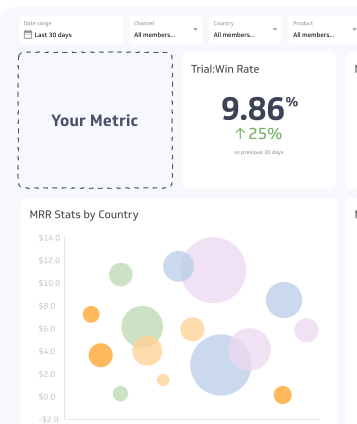
How to visualize Net Income?
Use a summary chart to visualize your Net Income data and compare it to a previous time period.
Net Income visualization example

Summary Chart
Here's an example of how to visualize your current Net Income data in comparison to a previous time period or date range.

Net Income
Chart
Measuring Net IncomeMore about Net Income
Why net income matters
Net Income is the single number that answers the most fundamental business question: did the company make money?
For investors, Net Income signals whether a business generates returns worth the risk. Consistent growth in Net Income over multiple periods suggests a healthy business model. A sudden drop may indicate rising costs, shrinking margins, or broader market pressure.
For analysts, Net Income is a starting point for valuation models, earnings-per-share (EPS) calculations, and competitive benchmarking. It feeds directly into price-to-earnings (P/E) ratios and discounted cash flow (DCF) analysis.
For management, Net Income reveals how well the business controls costs relative to revenue. A growing top line paired with flat or declining Net Income points to cost inefficiencies or pricing pressure that needs attention.
Net income vs. related metrics
Net Income is often confused with similar terms. The distinctions matter.
| Metric | What it excludes | Best used for |
|---|---|---|
| Gross Profit | Operating expenses, taxes, interest | Measuring production efficiency |
| Operating Income (EBIT) | Taxes and interest | Evaluating core business performance |
| EBITDA | Taxes, interest, depreciation, amortization | Comparing operational performance across capital structures |
| Net Income | Nothing — all costs deducted | Final profitability; shareholder returns |
Each metric strips away a different layer of cost. Net Income is the most complete view because nothing is excluded.
Common variations in how net income is reported
Net Income is not always calculated the same way. Meaningful differences exist depending on context.
Net Income attributable to common shareholders excludes preferred dividends. This version feeds into EPS calculations and is most relevant to common equity investors.
Adjusted Net Income (or "non-GAAP Net Income") strips out one-time items like restructuring charges, asset write-downs, or acquisition costs. Companies often highlight this figure to show underlying performance, but readers should scrutinize what has been excluded and why.
Net Income margin expresses Net Income as a percentage of revenue, making profitability comparable across companies of different sizes:
Net Income Margin = (Net Income / Revenue) × 100
A company with $700,000 in Net Income on $2,000,000 in revenue has a 35% Net Income margin. That context matters more than the absolute dollar figure alone.
Best practices for tracking net income
Track the trend, not just the number. A single period's Net Income tells you little. Quarter-over-quarter and year-over-year trends reveal whether profitability is improving, stable, or deteriorating.
Pair Net Income with cash flow. Net Income is an accounting figure, not a cash figure. A business can report positive Net Income while running low on cash due to timing differences in receivables, payables, and capital expenditures. Always review Net Income alongside the cash flow statement.
Segment by business unit or product line. Aggregate Net Income can mask underperforming areas. Breaking it down by division or product line helps management identify where margin is being created or destroyed.
Normalize for one-time items. Large non-recurring gains or losses, such as asset sales or litigation settlements, can distort Net Income in a given period. Adjusting for these items gives a cleaner picture of ongoing profitability.
Common challenges and misinterpretations
Accrual accounting creates timing gaps. Revenue is recognized when earned, not when cash is received. This means Net Income can look strong even when a business is cash-constrained.
Depreciation and amortization reduce Net Income without affecting cash. This is why capital-intensive businesses often trade at multiples of EBITDA rather than Net Income. The metric understates cash generation for asset-heavy companies.
One-time items can mislead. A company that sells a building at a gain will show a spike in Net Income that has nothing to do with operating performance. Readers should always check the income statement notes for non-recurring items.
Earnings management is a real risk. Accounting choices, such as revenue recognition timing, inventory valuation methods, and depreciation schedules, can all influence reported Net Income within the bounds of GAAP. This is why analysts cross-reference Net Income with cash flow from operations to check for consistency.
Net Income Frequently Asked Questions
What is net income?
Net Income is the profit remaining after subtracting all expenses, including COGS, operating costs, taxes, and interest, from total revenue. It is the final line on the income statement and the most complete measure of a company's profitability.
What is the formula for net income?
Net Income = Revenue - COGS - Operating Expenses - Taxes - Interest Expenses.
What is the difference between net income and gross profit?
Gross Profit subtracts only COGS from revenue, leaving operating expenses, taxes, and interest uncounted. Net Income deducts all costs, making it a more complete measure of profitability.
Why can a company have positive net income but low cash?
Net Income is an accrual accounting figure. Revenue is recognized when earned, not when cash is received. Timing differences in receivables, payables, and capital expenditures mean a business can report profit while still running low on cash.
What is net income margin?
Net Income Margin is Net Income expressed as a percentage of revenue: (Net Income / Revenue) × 100. It makes profitability comparable across companies of different sizes.