A manufacturing company holds $7,000 in cash and bank deposits, a $5,500 money market fund, and $5,000 in treasury bills maturing in 60 days. CCE = $7,000 + $5,500 + $5,000 = $17,500. This means the company has $17,500 available to meet immediate obligations without liquidating any longer-term assets.
Cash and Cash Equivalents (CCE)
Last updated: Aug 18, 2026
What is Cash and Cash Equivalents?
Cash and Cash Equivalents (CCE) is the total value of a company's cash on hand plus short-term liquid assets convertible to cash within three months. CCE appears as the first line item on a company's balance sheet and is a primary indicator of liquidity. A strong CCE balance signals the ability to meet operating obligations, service short-term debt, and fund growth without external financing.
Cash and Cash Equivalents Formula
ƒ Cash on Hand + Cash Equivalents
How to calculate Cash and Cash Equivalents
Start tracking your Cash and Cash Equivalents data
Use PowerMetrics, modern analytics platform, to monitor your data. Choose a service below to start tracking your Cash and Cash Equivalents instantly.

How to visualize Cash and Cash Equivalents?
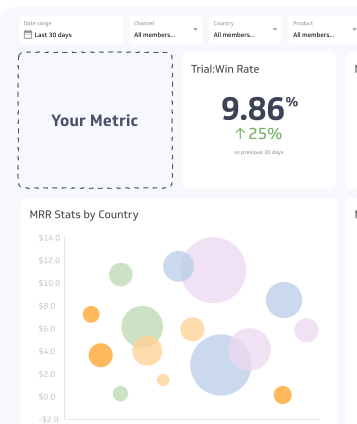
Use a summary chart to visualize your Cash and Cash Equivalents, comparing the metric to a previous period.
Cash and Cash Equivalents visualization example

Summary Chart
Here's an example of how to visualize your current Cash and Cash Equivalents data in comparison to a previous time period or date range.

Cash and Cash Equivalents
Chart
Measuring Cash and Cash EquivalentsMore about Cash and Cash Equivalents
Why CCE matters
CCE is one of the clearest indicators of a company's financial health. A business with strong CCE can pay suppliers, cover payroll, service short-term debt, and invest in growth without relying on external financing.
The amount of CCE available to cover operating obligations is often called runway, particularly in early-stage and growth-stage companies. In periods of economic uncertainty, extending runway becomes a priority, and CCE is the metric that defines it.
Investors and lenders also use CCE to assess liquidity risk. A low CCE balance relative to current liabilities signals potential solvency concerns, while a consistently high balance may prompt questions about capital deployment efficiency.
Tracking CCE with a cash flow statement
The movement of cash into and out of a business is tracked using a cash flow statement. This statement categorizes all cash activity into three types:
- Operating activities: Cash generated or used in day-to-day business operations, such as customer payments received and supplier payments made
- Investing activities: Cash used to purchase or received from selling long-term assets, such as equipment or securities
- Financing activities: Cash from borrowing, repaying debt, or issuing equity
The ending balance on the cash flow statement reconciles to the CCE figure on the balance sheet. Monitoring changes in CCE across periods helps identify whether a business is generating or consuming cash through its core operations.
What qualifies as a cash equivalent
Not all short-term assets qualify as cash equivalents. To be classified as a cash equivalent, an asset must meet two criteria:
- High liquidity: It can be converted to a known amount of cash quickly and with minimal transaction cost
- Short maturity: It matures within three months of the acquisition date
Common examples include:
- Treasury bills
- Commercial paper
- Money market funds
- Short-term government bonds (within the maturity threshold)
Accounts receivable does not qualify as a cash equivalent because collection timing is uncertain. Inventory and prepaid expenses are also excluded.
Common challenges in measuring CCE
Restricted cash: Some cash balances are legally restricted and cannot be used for general operations, such as escrow deposits or regulatory reserves. Restricted cash should be reported separately and excluded from CCE. Misclassifying restricted cash inflates the CCE figure and overstates liquidity.
Foreign currency holdings: Companies operating internationally may hold cash in multiple currencies. Exchange rate fluctuations affect the reported CCE value, and accounting standards require translation at the rate in effect on the balance sheet date.
Overdraft facilities: In some jurisdictions, bank overdrafts that are repayable on demand and integral to cash management are netted against CCE. Treatment varies by accounting standard (IFRS vs. GAAP), so consistency in methodology matters.
Interpreting high CCE: A large CCE balance is not always a positive signal. It may indicate that management is not deploying capital effectively into growth opportunities. Context, including industry norms and business stage, is essential when benchmarking CCE levels.
CCE and related metrics
CCE does not operate in isolation. Use it alongside:
- Current ratio: Current assets / current liabilities. CCE is a component of current assets; a current ratio above 1.0 generally indicates adequate short-term liquidity
- Quick ratio: (Cash + Cash Equivalents + Short-term investments + Receivables) / current liabilities. A stricter liquidity measure that excludes inventory
- Operating cash flow: The cash generated from core operations each period; a sustained positive figure supports a healthy CCE balance over time
- Burn rate: For growth-stage companies, the monthly rate at which CCE is consumed. Burn rate and CCE together determine runway in months
Tracking these metrics together gives a more complete picture of liquidity than CCE alone.
Cash and Cash Equivalents Frequently Asked Questions
What is included in Cash and Cash Equivalents?
Cash and Cash Equivalents includes physical currency, bank deposits, and short-term liquid investments that mature within three months, such as treasury bills, commercial paper, and money market funds. Accounts receivable, inventory, and restricted cash are excluded.
Where does CCE appear on financial statements?
CCE appears as the first line item on a company's balance sheet under current assets. It is also the ending balance reconciled on the cash flow statement.
What is a good CCE level?
There is no universal benchmark for CCE. The appropriate level depends on industry, business stage, and operating obligations. A useful reference point is whether CCE covers at least three to six months of operating expenses, though capital-intensive industries and high-growth companies may require more.
Recommended resources related to Cash and Cash Equivalents
An introduction to your cash runway, by the SaaS CFO.Contributor