SaaS Quick Ratio measures how efficiently a SaaS company grows Monthly Recurring Revenue by comparing revenue gained through new customers and expansions against revenue lost through churn and downgrades.
A SaaS company ends the month with New MRR of $40,000, Expansion MRR of $10,000, Churn MRR of $12,000, and Contraction MRR of $3,000.
SaaS Quick Ratio = ($40,000 + $10,000) / ($12,000 + $3,000) = $50,000 / $15,000 = 3.3
The company earns $3.30 in new and expanded revenue for every $1.00 lost. Growth is occurring, but tightening retention would meaningfully improve efficiency.
| SaaS Quick Ratio | Signal |
|---|
| 4 or higher | Healthy; efficient growth, strong retention |
| 2–4 | Moderate; growth is happening but retention needs attention |
| Below 2 | Concerning; revenue leakage is undermining growth |
Early-stage companies are generally considered healthy at a ratio of 4 or higher. That benchmark becomes harder to sustain as the business scales and the customer base grows larger and more diverse.
There is no universal threshold. A ratio of 3 for a company in a highly competitive vertical with strong net revenue retention may be more impressive than a ratio of 5 for a business with minimal expansion revenue. Context matters.
Benchmark ranges are based on commonly cited SaaS industry guidance. Thresholds vary by stage, market, and business model.
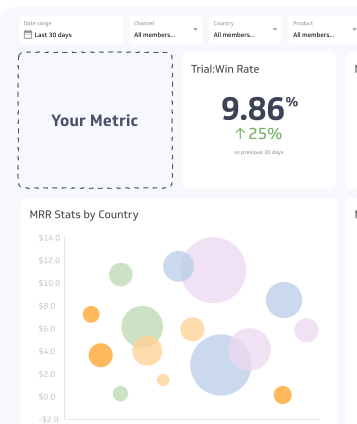
Ratios are usually expressed as single-digit numbers so it would be optimal to visualize SaaS Quick Ratio with a summary chart. Summary charts compare current values to a previous time period.
Why SaaS Quick Ratio matters
Many early-stage SaaS companies focus almost entirely on new MRR. The problem: without accounting for revenue lost to churn and downgrades, growth figures can be deeply misleading.
Think of it like filling a tank with holes. A company adding $50,000 in new MRR each month sounds healthy, but if $25,000 is leaking out, the business needs twice the sales effort just to stay in place.
SaaS Quick Ratio makes that leakage visible. It reframes growth as a net efficiency question, not just a top-line one.
The cost of a low ratio
A SaaS Quick Ratio of 2.0 means you're losing half of every dollar of new MRR. Given that customer acquisition costs typically take 12 or more months to recover, a low ratio creates a compounding cash problem. The business must spend more and more just to maintain its current revenue base.
This is why investors increasingly ask for SaaS Quick Ratio alongside monthly recurring revenue. It separates companies that are growing efficiently from those that are growing expensively.
How to improve SaaS Quick Ratio
If your ratio is below 4 and new MRR growth is strong, the problem is almost always retention.
Reduce churn MRR by:
-
Identifying at-risk accounts early — Use product usage data and engagement signals to flag customers before they cancel
-
Improving onboarding — Poor onboarding is a leading cause of early churn; structured activation sequences reduce it
-
Addressing cancellation reasons directly — Analyse exit surveys and cancellation data to find patterns, then fix the underlying issues
Increase expansion MRR by:
-
Building upgrade triggers into the product — Usage limits, feature gates, and milestone moments create natural expansion opportunities
-
Training customer success on expansion — Proactive check-ins often surface upgrade conversations that customers wouldn't initiate themselves
-
Offering usage-based pricing tiers — Pricing that scales with value makes expansion feel earned, not upsold
Common mistakes when using SaaS Quick Ratio
Treating it as a vanity metric. Some teams calculate SaaS Quick Ratio for investor reporting but don't connect it to operational decisions. If the ratio isn't influencing retention priorities or pricing strategy, it's not being used.
Ignoring contraction MRR. Downgrades are easy to undercount, especially if billing systems don't cleanly separate them from churn. Including contraction MRR in the denominator gives a more accurate picture.
Optimizing the ratio without improving the business. It's possible to inflate SaaS Quick Ratio by suppressing expansion MRR reporting or delaying churn recognition. Track the metric alongside gross MRR churn rate to keep it honest.
Benchmarking against the wrong companies. A consumer SaaS product with high monthly churn operates differently from an enterprise B2B product with annual contracts. Compare your ratio against businesses with a similar model.
SaaS Quick Ratio and investor conversations
If your company has a strong SaaS Quick Ratio, make it part of your investor narrative. Many early-stage investors focus on top-line MRR growth and miss the efficiency story underneath. A ratio of 4 or higher demonstrates that growth is sustainable, not just fast.
When competing for follow-on funding, SaaS Quick Ratio is one of the cleaner ways to show that your unit economics hold as you scale.


.jpg)