Looking at some recent JMP research, the average SaaS company goes public at around $25M/quarter in revenue, a $100M annual run-rate, and which also suggests an ARR base of around $100M. The average SaaS company has raised about $100M if you include everyone or $68M if you exclude companies not considered enterprise software. This suggests that 1.5 (=100/68) is a typical capital-to-ARR ratio or Hype Factor, on the eve of an IPO.
Hype Factor
Last updated: Jun 04, 2026
What is Hype Factor?
Hype Factor is an efficiency metric that shows how efficiently a company converts capital raised into ARR. SaaS companies convert venture capital into two things: annual recurring revenue (ARR) and hype. ARR has direct value as every year it turns into GAAP revenue. Hype has value to the extent it creates halo effects that drive interest in the company that ultimately increase ARR.
Alternate names: Hype RatioHype Factor Formula
ƒ Sum(Capital Raised) / Sum(Annual Recurring Revenue)
How to calculate Hype Factor
Start tracking your Hype Factor data
Build and track this metric in PowerMetrics, a modern analytics platform that lets you define metrics and connect your own data.
Get PowerMetrics Free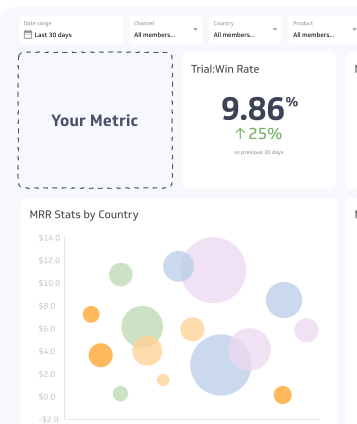
What is a good Hype Factor benchmark?
A hype factor of 1-2 is target. A hype factor of 2-3 is good, particularly well before an IPO. A hype factor of 3-5 is not good, too much hype and too little ARR. A hype factor of 5+ suggests there is very little “there there” at all.
Lower Hype Factor indicates more efficient capital conversion into revenue, suggesting strong product-market fit and operational discipline.
How to visualize Hype Factor?
A summary chart is the best way to visualize Hype Factor. Summary Charts display the current value in comparison with the past. Take a look at the example:
Hype Factor visualization example

Summary Chart
Here's an example of how to visualize your current Hype Factor data in comparison to a previous time period or date range.

Hype Factor
Chart
Measuring Hype FactorMore about Hype Factor
Hype takes two forms: good hype that drives ARR and wasted hype that simply makes the company famous for being famous. Since private companies raise capital and burn it down until an IPO, you should expect that the above values represent minima from a lifecycle perspective. In theory, you’d arrive on IPO day having efficiently deployed all raised capital.
Limitations to this approach include how much VC is left over on the eve of the IPO or how much debt the company had raised, capital consumption per category that may vary as a function of the category, and that the ARR run-rate calculations should only apply to subscription.
Hype Factor Frequently Asked Questions
How does Hype Factor differ from other capital efficiency metrics like Burn Multiple or CAC Ratio?
Hype Factor is a cumulative, lifecycle metric that evaluates total capital efficiency from inception to a specific point (typically IPO), while Burn Multiple and CAC Ratio are point-in-time operational metrics measured quarterly or annually. Hype Factor answers "How much total capital did we need to reach this revenue scale?" whereas Burn Multiple asks "How efficiently are we converting cash into growth this quarter?" Both are valuable but serve different purposes: use Hype Factor for strategic assessment and benchmarking against peers at similar stages (particularly useful for late-stage companies or IPO readiness), and use Burn Multiple for ongoing operational management and identifying efficiency trends. A company can have excellent recent Burn Multiple (1.0x) but poor Hype Factor (5.0x) if they were inefficient in early years, or vice versa. Hype Factor is particularly useful for investors evaluating whether a company over-raised relative to value created, while operators focus more on current-period metrics like Burn Multiple to drive day-to-day decisions.
What's considered "good hype" versus "wasted hype," and can we measure the difference?
Good hype directly drives revenue growth through brand awareness that shortens sales cycles, attracts higher-quality customers, enables premium pricing, or creates network effects that reduce customer acquisition costs. Wasted hype generates buzz without business impact—media coverage, awards, conference appearances, or social media presence that don't translate to pipeline or conversions. Measuring the difference requires tracking leading and lagging indicators: good hype shows up in metrics like increased inbound lead volume, improved win rates, shorter sales cycles, higher NPS, easier recruiting, or lower CAC following publicity. Wasted hype shows high brand awareness scores or media mentions but flat or declining revenue efficiency metrics. Practically, compare periods of high visibility (product launch, funding announcement, media coverage) against subsequent quarters' CAC Ratio and pipeline generation—if CAC improved or pipeline increased 20-30% following major publicity, that's good hype. If metrics stayed flat despite widespread coverage, you're generating wasted hype. Companies with low Hype Factors (1-2x) typically excel at converting brand investment into revenue outcomes, while high Hype Factors (4-5x+) often indicate over-investment in visibility without corresponding commercial discipline.
Our Hype Factor is 4.5x at $10M ARR. Is it too late to improve this, or are we permanently disadvantaged?
It's not too late, but you must dramatically improve forward efficiency to offset past capital inefficiency. Hype Factor is cumulative, so past over-raising or burn can't be undone, but you can improve the metric's trajectory by growing ARR faster than you raise/burn additional capital. For example, if you've raised $45M to reach $10M ARR (4.5x Hype Factor), reaching $40M ARR while raising only $15M more would improve your Hype Factor to $60M / $40M = 1.5x—a much stronger position. The key is demonstrating to future investors or public markets that past inefficiency was a learning phase, not a permanent characteristic. Practically: focus obsessively on capital-efficient growth (target <1.0x Burn Multiple going forward), consider raising smaller rounds or bridge financing instead of large rounds, and potentially pursue profitability earlier than typical to prove unit economics work without continuous capital infusion. Many successful companies had poor early efficiency but became iconic by achieving inflection points in capital productivity. However, be realistic: a 4.5x Hype Factor at $10M ARR suggests you may need to reach $50-75M ARR with minimal additional capital to convince markets you've found product-market fit and operational discipline. Document and communicate the operational changes you've made to improve efficiency—investors value the trajectory and learnings, not just the absolute numbers.
Recommended resources related to Hype Factor
Dave Kellogg introduces and discusses Hype Ratio.Contributor


Podcast Episode
Metric StackHype Factor