What is Average Revenue Per Account?
Average Revenue Per Account (ARPA) represents the mean revenue generated from each customer account over a specific period, typically calculated monthly or annually. Beyond serving as a simple revenue indicator, ARPA functions as a critical strategic metric that reflects your product's value proposition, market positioning, pricing effectiveness, and customer segmentation strategy. It directly influences unit economics, growth sustainability, and competitive positioning while providing actionable insights into customer behaviour, expansion opportunities, and market penetration across different segments and growth stages.
Average Revenue Per Account Formula
How to calculate Average Revenue Per Account
Consider a SaaS company with 1,000 paying accounts generating $100,000 in monthly recurring revenue.
The monthly ARPA would be calculated as: ARPA = $100,000 ÷ 1,000 = $100 per account per month.
For annual calculations, multiply monthly ARPA by 12 ($1,200 annually) or calculate directly using annual revenue figures. When analysing ARPA, always ensure consistency in time periods and account definitions across comparisons.
Start tracking your Average Revenue Per Account data
Build and track this metric in PowerMetrics, a modern analytics platform that lets you define metrics and connect your own data.
Get PowerMetrics Free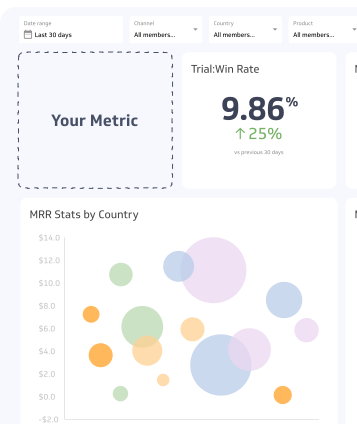
What is a good Average Revenue Per Account benchmark?
ARPA benchmarks vary significantly across market segments and business models.
- Small business-focused SaaS typically sees monthly ARPA ranging from $10-$100, with successful companies achieving $50-$150 as they mature and expand feature sets.
- Mid-market solutions generally command $200-$2,000 monthly ARPA, reflecting more complex needs, longer implementation cycles, and higher switching costs.
- Enterprise SaaS platforms often achieve $2,000-$50,000+ monthly ARPA, driven by comprehensive feature sets, customisation requirements, and substantial business impact.
Industry-specific variations are substantial, with vertical SaaS solutions often commanding 2-3x higher ARPA than horizontal tools due to specialised functionality and compliance requirements.
High-growth SaaS companies typically target 15-25% annual ARPA growth through a combination of pricing optimisation, feature expansion, and customer mix improvements. However, mature markets may see single-digit ARPA growth as market saturation increases and competitive pressure intensifies.
Companies should benchmark against similar-stage competitors within their specific market segment rather than relying on broad industry averages.
How to visualize Average Revenue Per Account?
Use a summary chart to visualize your Average Revenue Per Account data and compare the current value to a previous time period.
Average Revenue Per Account visualization example

Summary Chart
Here's an example of how to visualize your current Average Revenue Per Account data in comparison to a previous time period or date range.
More about Average Revenue Per Account
The ARPA trend over time provides crucial perspective on the evolving value of your company's products and services, with most industries targeting consistent increases that outpace inflation and competitive pressures. Changes in ARPA can reflect strategic pricing adjustments, successful account expansion through upselling and cross-selling, customer maturation and increased usage, or conversely, account contraction due to downgrading, competitive pressure, or economic headwinds. Understanding these underlying drivers enables leaders to make informed decisions about resource allocation, sales strategy, and product development priorities.
Comparing ARPA trends across different account segments reveals powerful insights for strategic decision-making. For instance, if you're focused on increasing overall revenue through higher initial purchase values, tracking new account ARPA trends provides direct visibility into your sales team's effectiveness at positioning premium offerings and qualifying higher-value prospects. Similarly, segmenting ARPA by customer size (SMB vs. enterprise), industry vertical, acquisition channel, or product line helps identify which segments drive the highest value and deserve increased investment. Companies with multiple product lines should analyse ARPA by offering to understand which solutions command premium pricing and drive account expansion, informing both product roadmap decisions and sales compensation structures.
For freemium models, excluding free accounts from ARPA calculations provides a clearer picture of monetisation effectiveness, though tracking conversion rates from free to paid alongside paid ARPA offers comprehensive insight into the freemium funnel's performance. Advanced ARPA analysis should also consider cohort-based trends, examining how ARPA evolves for customers acquired in different periods, revealing the impact of product improvements, market positioning changes, or shifts in customer quality over time.
Average Revenue Per Account Frequently Asked Questions
How should we balance growing ARPA versus expanding customer count, especially when resources are limited?
The answer depends heavily on your unit economics and growth stage, but generally follows a strategic progression that maximizes long-term value creation. Early-stage companies should prioritize customer acquisition to achieve market validation and economies of scale, accepting lower initial ARPA in exchange for market penetration and learning opportunities. However, once you've established product-market fit, focus should shift toward ARPA optimization through strategic pricing, feature tiering, and customer success initiatives that drive expansion revenue. Calculate your Customer Lifetime Value to Customer Acquisition Cost ratio (LTV:CAC) for different scenarios - if increasing ARPA by 20% requires the same effort as acquiring 30% more customers, choose the path that delivers superior unit economics and sustainable competitive advantages. Mid-market and enterprise companies should generally prioritize ARPA growth, as these segments offer more expansion potential, higher retention rates, and better reference value for future sales efforts.
Our ARPA is declining despite overall revenue growth - should we be concerned, and how do we address this trend?
Declining ARPA amidst revenue growth typically indicates customer mix shifts toward lower-value segments, which isn't inherently problematic if it aligns with your strategic goals and maintains healthy unit economics. First, segment your analysis to understand whether existing customers are contracting (concerning) or you're successfully acquiring more small customers (potentially positive). If existing customer ARPA is declining, investigate whether this reflects economic pressure, competitive threats, or inadequate customer success efforts - each requiring different responses ranging from pricing strategy adjustments to enhanced onboarding and expansion programs. If the decline results from acquiring smaller customers, evaluate whether these segments offer acceptable LTV:CAC ratios, reasonable payback periods, and potential for future expansion. Sometimes, strategically accepting lower ARPA to achieve market penetration, competitive positioning, or economies of scale makes business sense, provided you have clear plans for eventual ARPA recovery through product evolution, market expansion, or customer maturation.
How do we set realistic ARPA growth targets, and what operational changes are needed to achieve them?
Setting effective ARPA growth targets requires analyzing historical trends, competitive positioning, market maturity, and internal capabilities to establish ambitious yet achievable goals. Start by decomposing ARPA growth into its components: price increases, feature expansion, customer mix improvements, and expansion selling success rates. Healthy SaaS companies typically target 15-25% annual ARPA growth in high-growth markets, moderating to 5-15% in mature markets. However, your specific target should reflect your market position, customer concentration, and competitive dynamics.
Operationally, achieving ARPA growth requires coordinated efforts across multiple functions. Product teams must develop features and tiers that justify higher pricing while sales teams need training on value-based selling and objection handling for premium offerings. Customer success teams become crucial for identifying expansion opportunities and preventing contraction, requiring investment in usage analytics, health scoring, and proactive engagement programs. Marketing must refine messaging to attract higher-value prospects while finance should implement pricing analytics and customer profitability analysis to guide strategic decisions. Most importantly, establish clear accountability metrics for each team's contribution to ARPA growth, whether through initial deal size improvements, expansion revenue targets, or churn prevention goals, ensuring alignment across the organization toward your revenue optimization objectives.