A Customer Health Score is a single, calculated number that reflects a customer's health across multiple dimensions. By monitoring Customer Health Scores, you can detect early signals of increased friction or declining customer engagement, and identify highly engaged clients who would make excellent advocates.
A company includes 4 evenly weighted dimensions in its Customer Health Score: Product Usage, Customer Support, Customer Satisfaction, and Business Outcomes. A key customer scores 80%, 60%, 75%, and 60% on each dimension.
Customer Health Score = (80 + 60 + 75 + 60) / 4 = 69%
A score of 69% signals moderate health, with support responsiveness and business outcomes as the clearest areas for improvement.
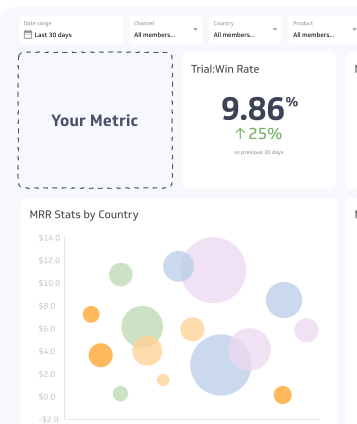
Generally, you can use a summary chart to visualize your Customer Health Score. Take a look at the sample chart:
How to use Customer Health Scores effectively
Monitor against a baseline
A single score in isolation has limited value. Track each customer's score over time against a defined baseline or threshold. A score that drops 10 points over 60 days is a more meaningful signal than a static number.
Set thresholds for action:
- Green (healthy): Customer is engaged and achieving outcomes. Focus on expansion and advocacy opportunities.
- Yellow (at risk): Declining engagement or satisfaction. Trigger a proactive outreach from a Customer Success Manager.
- Red (critical): Significant drop in usage or satisfaction. Escalate immediately with a structured recovery plan.
Weighted vs. equal scoring
Not all dimensions carry equal weight for every business. A SaaS company with a complex product may weight Product Usage and Business Outcomes more heavily. A services firm may weight Relationship Strength and Satisfaction above all else.
Document your weighting rationale and revisit it periodically. As your product and customer base evolve, the relative importance of each dimension may shift.
Automate signals and responses
Most modern Customer Success platforms include built-in health score tracking. Connect your health score to automated workflows:
- A score dropping below a threshold triggers an automated check-in email ("tech touch")
- A score reaching a critical low escalates to a live Customer Success Manager conversation
- A score climbing into the top tier triggers an advocacy or expansion outreach
Automation ensures no customer slips through the cracks, regardless of portfolio size.
Internal vs. customer-facing scores
Some companies keep Customer Health Scores internal, using them purely for team prioritization. Others share scores directly with customers, using them as a starting point for quarterly business reviews and forward-looking conversations.
Sharing scores with customers can build transparency and accountability, but requires clear communication about what each dimension means and how the score is calculated. Customers should understand what actions on their end can improve their score.
Common challenges
Choosing the wrong dimensions: Including dimensions that don't correlate with actual retention or expansion dilutes the score's predictive value. Validate your dimensions against historical churn and renewal data before locking in your model.
Overweighting lagging indicators: Satisfaction surveys reflect the past. Balance them with leading indicators like feature adoption and login frequency, which signal future behaviour.
Gaming the score: If teams are measured on health score averages, there's a risk of inflating scores through superficial interactions. Tie health scores to outcomes, not activity counts.
Stale data: A health score is only as good as the data feeding it. Ensure your integrations are pulling fresh data on a consistent cadence, and flag any dimension where data is missing or delayed.


.jpg)